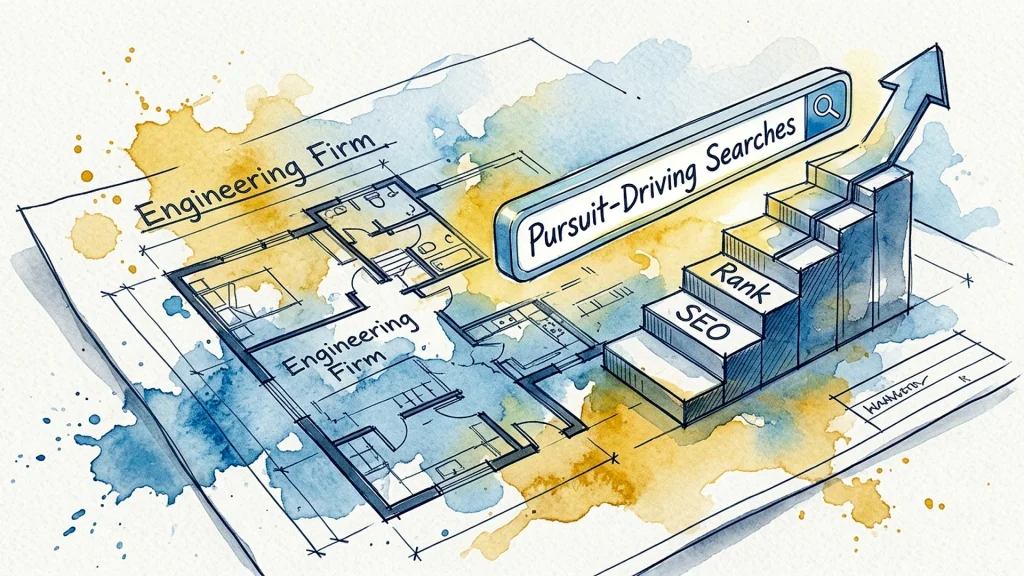
Referrals still win work in the engineering world. But here’s what’s changing fast: owner project managers and selection committee members increasingly begin their pursuit research online, often weeks before any RFQ hits your inbox. If your structural or MEP firm doesn’t surface during those early searches, you’re simply not in the running. Search visibility isn’t a marketing luxury anymore. It’s a pursuit prerequisite!
A smart AEC SEO strategy becomes a genuine competitive advantage here. Not generic SEO, but pursuit-driven SEO. The kind that puts your firm directly in front of decision-makers searching for discipline-specific capability at exactly the right moment. As part of a broader approach to marketing for engineering firms: how to turn technical expertise into a website that wins work and talent, search visibility is the foundation everything else builds on. Let’s dig into what actually moves the needle!
Understanding the Pursuit-Driven Search Landscape
- Pursuit-driven searches signal active decision-making, not casual browsing
- Three distinct buyer personas search for engineering firms with very different intent
- Engineering SEO demands discipline-specific and project-type keyword architecture
- Most firms optimize for vanity terms and miss engineering firm Google ranking pursuit keywords that trigger real inquiries
Not all searches are created equal, and for engineering firms, that distinction is everything! “Engineering firms near me” is a generic query. “MEP engineer for life sciences laboratory fit-out” is a pursuit-driven search. That second query signals active decision-making, a real project, and a buyer ready to shortlist. Your strategy lives or dies on whether your website shows up for the second type.
Consider this: a civil engineering firm that shifted its keyword strategy toward project-type and sector-specific terms reported a measurable increase in inbound inquiries from qualified owner clients within six months. Generic rankings generated traffic. Pursuit-driven rankings generated proposals. The difference is significant!
Three primary buyer personas drive qualified engineering firm searches, and each thinks differently. Owner project managers research firms by discipline, sector, and delivery method. Developers seek specialty engineering capabilities tied to specific building types. Architects hunt for collaborative partners with proven experience matching their pipeline. Each persona uses distinct language, so your keyword strategy must reflect all three.
This is precisely why SEO for engineering firms differs from general professional services SEO. Long sales cycles, multi-disciplinary capabilities, and deep technical differentiation demand keyword architecture organized by discipline and project type. Targeting engineering firm Google ranking pursuit keywords like “MEP engineer for healthcare facility coordination” or “structural engineer design-build partner” captures buyers in active pursuit mode. Optimizing for “engineering services” or “consulting engineers,” by contrast, generates vanity rankings that rarely win work!
Building Technical Content Domain Authority
- Technical content domain authority engineering signals genuine expertise to search engines and decision-makers
- Discipline-specific keyword frameworks attract pursuit-ready searchers over generic terms
- On-page SEO requires natural technical language, structured problem-solving content, and project proof
- Topical authority clusters amplify rankings across related queries
Technical content is the engine behind domain authority for engineering firms. Publishing detailed case studies, methodology articles, and discipline-specific white papers sends powerful signals to search engines that your firm owns a topic. A structural firm publishing on seismic retrofit approaches, connection design philosophy, and peer review processes builds compounding authority that generic service pages simply cannot achieve. This is technical content domain authority engineering done right!
Keyword strategy must follow discipline lines and project types. Structural engineers should target phrases like “seismic retrofit design.” MEP firms should pursue “healthcare facility MEP coordination.” Civil firms should optimize for “stormwater management solutions.” This AEC SEO strategy for structural and MEP firms connects your content directly to pursuit-ready searchers, including owner project managers, developers, and architects researching firms right now.
On-page execution matters enormously! Use technical terminology naturally in page titles, H1s, H2s, and metadata. Structure each service page to answer the specific problems your discipline solves, then support every claim with real project examples. Vague capability statements won’t rank or convert, but precise, proof-backed content will. Build topical authority clusters deliberately, and track which clusters drive pursuit inquiries using engineering firm website analytics and KPIs to continuously sharpen your approach!
Local SEO for Multi-Office Engineering Firms
- Managing multiple Google Business Profiles without creating NAP inconsistencies
- Building location-specific keyword strategies that avoid cannibalizing rankings across offices
- Balancing central domain authority with genuine local relevance
Executing local SEO for multi-office engineering firms is one of the most technically demanding challenges in AEC digital strategy. Each office needs its own Google Business Profile (GBP), verified and fully optimized. However, inconsistent NAP (name, address, phone number) data across directories quietly destroys local rankings. Your Denver office can’t afford to appear with three different phone numbers across the web. Audit every listing, lock down consistency, and treat each profile as a living asset!
Location-specific keyword optimization is where strategy gets critical. Each office should target local modifiers alongside discipline terms. For example, “structural engineering firm in Denver” or “MEP engineer Houston healthcare” captures local pursuit intent effectively. Your website architecture must prevent competing pages from cannibalizing each other. Dedicated location pages with unique, substantive content solve this problem. Generic copy pasted across locations actively hurts your rankings.
The smartest multi-office firms build strong central domain authority through discipline-specific content and thought leadership, then channel that authority into location pages. This lets you compete locally without fragmenting your brand. Correlating local visibility improvements with incoming proposal opportunities reveals which markets generate real BD (business development) momentum, connecting directly to your engineering firm website analytics and revenue KPIs!
Adapting to AI-Generated Search Results
- AI Overviews now dominate informational searches, threatening click-through traffic
- Prioritizing commercial and transactional keywords protects pursuit-driven visibility
- Structured data and proprietary content help engineering firms get cited by AI systems
The search landscape is shifting fast, and engineering firms need to pay close attention! According to research from Circle S Studio, AI Overviews now reach over 2 billion monthly users, with informational searches triggering AI-generated summaries at rates as high as 80-88% in some industries. That means your firm can rank on page one and still lose the click. The rules of visibility are changing!
The immediate response is strategic keyword prioritization. Shift your AEC SEO strategy away from purely informational queries toward commercial and transactional keywords signaling active pursuit intent. Searches like “MEP engineering firm for healthcare projects in Dallas” or “structural engineer design-build partner” reflect decision-making behavior. AI summaries are far less likely to intercept those queries.
Beyond keyword targeting, structure your content to resist AI summarization. Include proprietary methodologies, project-specific case outcomes, and firm-specific credentials that AI systems cannot synthesize generically. Additionally, add structured data and schema markup so AI systems accurately attribute expertise back to your domain. The forward-looking strategy is building authority that’s genuinely hard to displace, through technical content, local presence, and story-driven differentiation that compounds over time!
Your Next Pursuit Starts With Being Found
SEO for engineering firms isn’t about chasing traffic for its own sake. It’s about being discoverable at the exact moment an owner’s project manager, a developer, or a selection committee member starts researching firms for an upcoming pursuit. That window is real, and it’s often short!
The strategies here work together as a system. Discipline-specific content builds domain authority. Local SEO ensures multi-office firms show up where opportunities exist. Structured service pages capture capability-specific queries. And AI-readiness keeps your firm visible as search behavior evolves rapidly in 2026 and beyond. Each element reinforces the others!
However, search visibility only delivers results when your website converts attention into confidence. If your site still reads like a brochure, rankings alone won’t move you from RFQ to shortlist. That’s why SEO belongs inside a broader marketing strategy for engineering firms built around story-driven differentiation. Storify specializes exclusively in AEC firms, and we’d love to help your firm rank for the searches that actually matter. Ready to build a web presence that gets found and wins work?