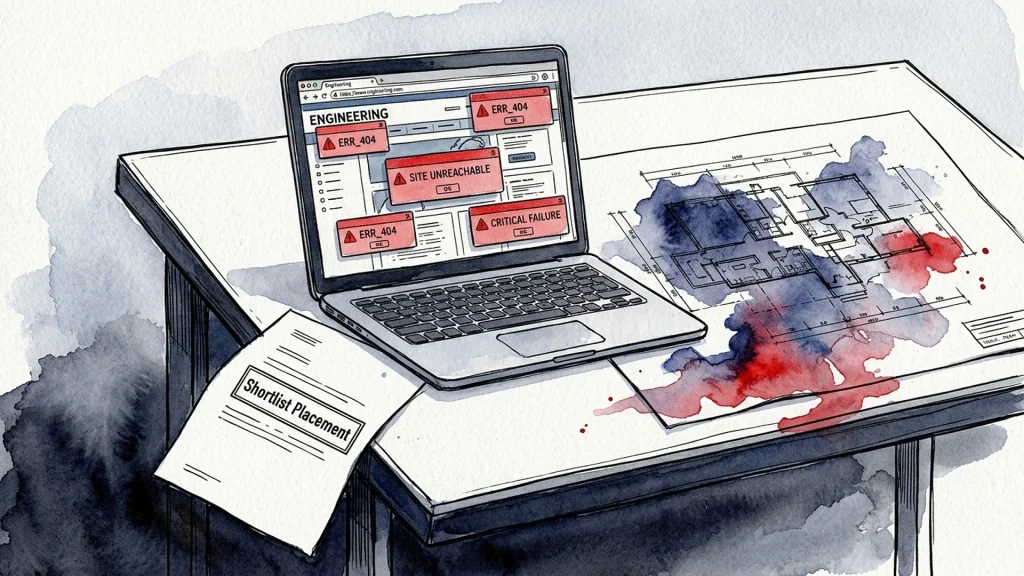
Your firm just submitted a strong RFQ. The credentials are solid, the project list is relevant, and the team has real technical depth. However, when the selection committee visits your website to validate their shortlist decision, they find something that looks like every other engineering firm they’ve already reviewed. Generic capability statements. Project pages with no technical narrative. No faces, no names, no story. That quiet, invisible moment is exactly where shortlist placements get lost.
Engineering firm website mistakes rarely announce themselves. They accumulate slowly, buried in outdated copy and brochure-style layouts that list what a firm does without explaining who they are. For principals and BD (business development) leaders at structural, MEP, civil, and specialty engineering firms, this gap between actual expertise and digital presence is a real competitive liability. Following AEC website best practices isn’t optional anymore; it’s the baseline for staying competitive.
This article is a diagnostic. It names the five most damaging patterns we see across AEC websites and shows you what to build instead. If you want to know specifically why your website isn’t moving pursuits forward, keep reading!
Generic Capability Statements That Kill Differentiation
- Phrases like “innovative solutions” and “client-focused” appear on nearly every engineering firm website and mean nothing to selection committees.
- Generic language forces evaluators to compare firms on price and size rather than judgment and expertise.
- A quick website audit reveals whether your messaging is truly yours or interchangeable with every rival in your market.
Open ten structural or MEP firm websites right now. You’ll find the same phrases repeated almost verbatim: “innovative solutions,” “proven expertise,” “client-focused approach.” This isn’t coincidence; it’s a pattern that signals a deeply costly engineering firm website mistake.
Here’s the real problem: selection committees evaluate firms on judgment and specialized experience. Generic capability statements communicate neither. As a result, evaluators default to comparing firms on price, size, and geography, factors that actively disadvantage mid-market firms competing against larger players.
The fix isn’t marketing polish; it’s specificity. Replace “proven expertise in complex projects” with the actual judgment calls your team makes: the structural systems you’ve advocated for under budget pressure, the MEP coordination challenges resolved on fast-track schedules, the measurable outcomes that resulted. That’s language only your firm can claim. That’s what moves BD teams from RFQ to interview!
Start with a focused engineering firm website audit. If a direct competitor could publish the same sentences without changing a word, you’re competing on the wrong terms entirely. For a broader positioning framework, explore what a $50M engineering firm can learn from how top competitors position themselves online.
Project Pages Without Technical Narrative
- Standard portfolios list scope, budget, and images but omit the technical judgment that actually demonstrates expertise.
- Six to nine deeply documented projects outperform fifty incomplete listings every time.
- Each project page must answer the challenge, the approach, and the measurable outcome.
- Minimum requirement: 2-3 richly documented projects per service line or specialty.
Most engineering firm project pages look identical: a photo, a square footage, a budget number, and a client name. That’s not a portfolio; that’s a receipt! Selection committees reviewing your shortlist submission need far more than proof that the work happened. They need proof that your firm brought genuine technical judgment to the problem.
Research confirms that six to nine well-documented projects with real technical narrative outperform fifty-plus incomplete listings every time. Volume doesn’t signal expertise; depth does. Furthermore, thin project pages hurt recruiting just as much as they hurt BD pursuits. Senior engineers evaluating your firm want to see the kinds of problems they’ll actually solve.
Every strong project page should answer three questions directly: What was the technical challenge? What specialized approach did your firm apply? What was the measurable outcome? Start with 2-3 deeply documented projects per service line. For a full framework, see our guide on marketing for engineering firms: how to turn technical expertise into a website that wins work and talent.
Invisible Engineers and Missing Team Credibility
- Engineering differentiation lives in specific people, but most websites hide them behind generic bios or principal-only profiles.
- Selection committees actively evaluate who will lead the project, not just which firm is proposing.
- Named engineers with linked project experience signal confidence, depth, and technical judgment.
Here’s a hard truth: your firm’s differentiation doesn’t live in your capability statement. It lives in the judgment and experience of specific engineers on your team. Yet most engineering firm websites feature only principals, or worse, a generic “Our Team” page with headshots and titles and nothing more. That’s a critical AEC website mistake!
Selection committees aren’t evaluating your firm in the abstract. They’re asking concrete questions: Who will lead this project? What have they built? When your website can’t answer those questions, committees fill the gap with doubt, and your ability to shortlist engineering firm pursuits suffers for it.
In contrast, effective engineering firm websites name specific engineers, list their credentials, and link them directly to the projects they’ve led. Start with your 5-10 most experienced, project-leading engineers. Name them. Link each person to the projects they’ve driven. That specificity builds trust, and trust wins shortlists!
Technical Jargon Without Context Alienates Committees
- Technical language without context loses non-engineer decision-makers on selection committees.
- Committees include both technical and non-technical stakeholders; your website must build confidence across all of them.
- A simple audit question: can a facility manager understand your website without an engineering degree?
One of the most damaging engineering firm website mistakes is writing exclusively for other engineers. Your team understands what nonlinear FEA modeling means. However, your client’s facility manager does not, and that facility manager may hold significant influence over who makes the shortlist.
The fix is translation, not dumbing down. For example, instead of listing a method, connect it to an outcome: “Advanced structural analysis that reduced material costs by 12% while meeting all safety requirements” communicates both technical judgment and tangible client value. That’s the story selection committees remember.
This matters most in competitive selections where three qualified firms look nearly identical on paper. Conduct a quick audit: hand your homepage to a non-technical colleague and ask if they understand what you do and why it matters. If they hesitate, your evaluation committee will too!
Positioning Your Site for an Engineering Company Website Redesign
- An engineering company website redesign should prioritize story-driven positioning over visual refresh.
- Every mistake above points to the same root problem: describing your firm instead of positioning it.
- Strategic fixes move BD teams from RFQ to interview consistently.
Every mistake covered here points to the same root problem: your website is describing your firm instead of positioning it. Generic capability statements, thin project pages, anonymous teams, and peer-facing jargon all send the same signal to selection committees. This firm doesn’t stand out. And firms that don’t stand out don’t make shortlists!
The good news? Every one of these mistakes is fixable. However, the fix isn’t a visual refresh or a content dump. An effective engineering company website redesign requires a strategic shift toward story-driven positioning that communicates your technical judgment, your people, and your point of view.
Start by auditing your site against these five patterns honestly. Then benchmark your positioning against firms already winning with what a $50M engineering firm can learn from how top competitors position themselves online. Ready to build a website that actually moves your BD team from RFQ to interview? Dive deeper into the full strategy with our guide on marketing for engineering firms: how to turn technical expertise into a website that wins work and talent, and let’s get your firm on more shortlists!