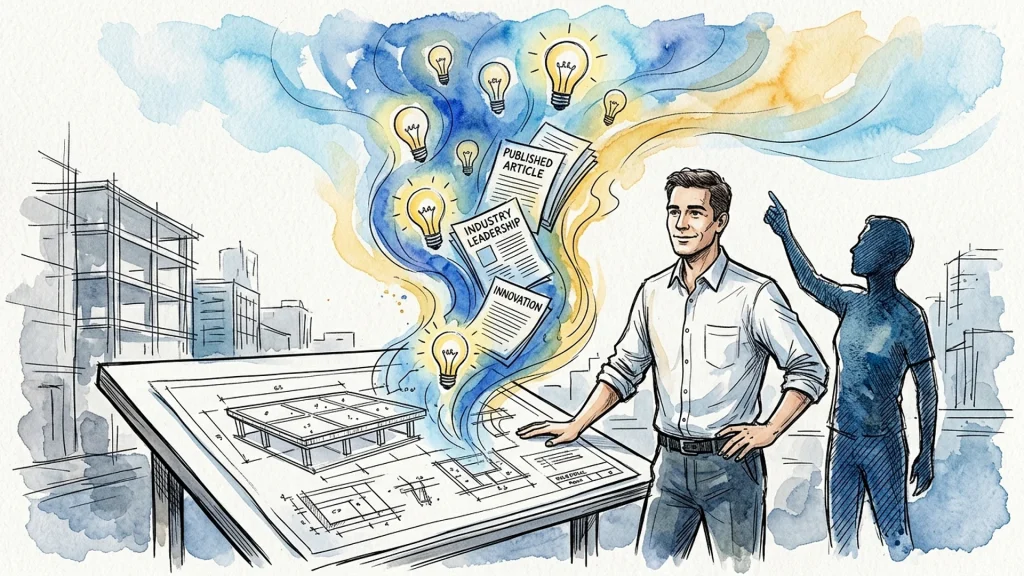
Your senior structural engineer just spent 30 minutes explaining why she chose a post-tensioned slab system over conventional concrete framing for a complex healthcare project. That conversation contained more genuine thought leadership than most engineering firms publish in an entire year. The frustrating part? It happened in a project debrief, not on your website. If you’ve ever wondered how to get engineers to write blog content (or more accurately, how to stop waiting for that to happen), this framework is for you.
Getting billable technical staff to contribute content is one of the biggest operational bottlenecks in AEC firm marketing. Marketing directors hit walls trying to extract insights from principals who are already stretched thin. As a result, brochure-style websites list capabilities without ever communicating the technical judgment that actually wins work. However, the right technical content strategy for AEC firms doesn’t require engineers to write a single word. This article gives BD leaders and marketing directors a practical system to build months of differentiated content from just 30 minutes of an engineer’s time!
Why Engineers Resist Writing Content
- Engineers treat marketing content as a distraction from billable project work
- The “write a blog post” request conflicts with how engineers think and communicate
- Technical expertise locked in project files stays invisible to prospects and recruits
- Spare-time writing expectations ignore the reality of billable hour targets
Ask a senior structural or MEP (mechanical, electrical, and plumbing) engineer to write a blog post, and you’ll get polite resistance every time. It’s not laziness. Engineers are billable professionals first. Every hour spent on marketing narratives is an hour pulled from project delivery and client relationships. That tension is real, and ignoring it is why most thought leadership content for engineering firms never gets published.
The deeper problem is cognitive, not motivational. Engineers communicate through calculations, specifications, and basis-of-design documents, not polished marketing copy. Asking them to produce promotional content conflicts with their professional identity. Furthermore, when senior engineers see their firm’s website listing generic services and stock project photos, they reasonably conclude that content contribution won’t move the needle. Their skepticism is entirely justified. As explored in our guide on marketing for engineering firms: how to turn technical expertise into a website that wins work and talent, the website itself must earn engineers’ trust before they’ll invest in it.
Any sustainable approach to building thought leadership without writing for engineers must work around time constraints, not demand more of them!
Interview-Based Workflows: Extracting Thought Leadership Without Writing
- Structured interviews reduce the engineer’s burden to answering five prepared questions
- Marketing teams own transcription, editing, and production
- Interview-based content captures authentic technical judgment, not marketing copy
- Engineers become subject matter experts, not content creators
The single most effective shift your marketing team can make is this: stop asking engineers to write and start asking them to talk. Structured interviews transform thought leadership content for engineering firms from a dreaded assignment into a natural conversation. The engineer answers five prepared questions. That’s it!
Your marketing team conducts the interview, handles transcription, and shapes raw answers into publish-ready content. The engineer’s total time investment is roughly 30 minutes. That’s a realistic ask for a billable professional, and it produces content that genuinely reflects how your firm thinks and solves problems.
Discipline-specific question templates make this workflow even more powerful. For example, structural teams get questions about load path decisions. MEP teams answer prompts around system selection and energy performance trade-offs. Civil teams discuss site development constraints and regulatory navigation. These targeted prompts extract the precise technical judgment that differentiates your firm, particularly when you consider what $50M engineering firms can learn from how top competitors position themselves online.
Most importantly, this approach reframes the engineer’s role entirely. They aren’t content creators; they’re subject matter experts being interviewed about their craft. That distinction makes participation feel professional, not promotional, and it makes building thought leadership without writing for engineers genuinely sustainable!
Repurposing Technical Assets Into Multi-Channel Content
- Conference presentations, project debriefs, and technical reports already contain powerful raw material
- A single 45-minute debrief can yield a blog post, case study, and social snippets
- Repurposing shifts the burden from engineers to marketing teams
Here’s the good news: your engineers are already creating thought leadership content. They’re just not calling it that! Conference presentations, internal project debriefs, and technical reports are packed with exactly the insights and judgment calls that selection committees want to see. The content exists; it just needs reformatting for web audiences.
Consider what lives inside a single 45-minute internal project debrief. A structural team walks through a complex lateral system decision. An MEP group debates basis-of-design tradeoffs. Transcribe that conversation, extract the core insight, and your marketing team suddenly has a blog post, a project case study, and a week of social media snippets, all without scheduling another minute of engineer time!
This is the power of engineering firm SME content repurposing. The marketing team’s job isn’t creation; it’s extraction and adaptation. Engineers resist writing because it feels like extra work. However, when the content already exists in their workflow, the perceived burden drops dramatically. As Forbes identified, a defining 2026 thought leadership trend is teaching over telling. Engineers naturally teach through project examples and technical explanations, and that instinct translates directly to web content that builds trust with institutional clients!
Editorial Calendars Aligned With Pursuit Timelines
- Tie publishing schedules to RFP seasons and client decision windows
- Use seasonal engineering challenges as natural content anchors
- Embed content extraction into project debriefs and pursuit reviews
- Show senior engineers how their thought leadership directly supports BD outcomes
Arbitrary monthly publishing schedules fail engineering firms every time. Instead, build your editorial calendar around pursuit cycles, RFP (request for proposal) seasons, and client decision timelines. When prospects are actively evaluating firms, your published expertise lands with real force. That’s strategic timing, not coincidence!
Seasonal engineering challenges offer powerful, discipline-specific content anchors. MEP coordination conversations heat up before construction documents are due. Structural decisions peak during schematic design. Aligning content to those moments makes your thought leadership feel immediately relevant to prospects wrestling with exactly those problems.
Sustainability comes from embedding content extraction into existing workflows. Add a single content prompt to every project debrief. Ask your structural lead: “What’s the most common analysis mistake on this project type?” Ask your MEP engineer: “How did you choose between these two system strategies?” As a result, engineering firm SME content repurposing becomes effortless when the questions are already baked into the process.
Most importantly, show senior engineers the direct connection between their expertise and shortlist placement. When principals see that a published insight supported a specific pursuit, buy-in follows naturally. That’s the buy-in every marketing director desperately needs!
Your Engineers Already Have the Content
The biggest myth in engineering firm marketing is that you need writers to create thought leadership. You don’t! You need engineers willing to talk, and a system that turns those conversations into content that wins work.
Interview-based workflows remove the blank-page problem entirely. Repurposing existing technical assets multiplies your output without multiplying your ask. An editorial calendar tied to pursuit timelines makes every piece of content strategically purposeful. Thirty minutes with a senior structural engineer can fuel months of differentiated content. That’s a competitive advantage your competitors are leaving on the table right now!
However, content alone isn’t enough. It has to live somewhere that works. If your website can’t surface and amplify that technical expertise, the effort stalls before it reaches a selection committee. That’s exactly what our marketing for engineering firms guide addresses. Ready to stop leaving your firm’s expertise invisible? Storify helps engineering firms translate technical depth into story-driven websites that win shortlists and attract talent!