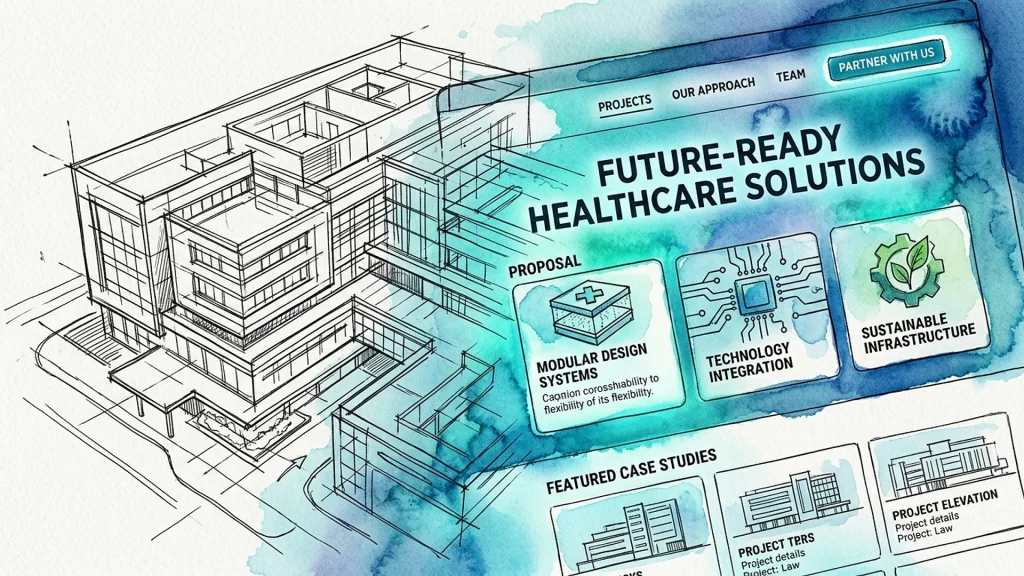
Your BD team submits a strong proposal for a $30M healthcare facility. The selection committee visits your website. What do they find? A generic project grid, a capabilities overview that reads like every competitor’s, and no clear signal that your firm has ever thought deeply about healthcare infrastructure. The shortlist opportunity evaporates before the interview invitation arrives.
This scenario plays out constantly across structural, MEP, civil, and specialty engineering firms, and it’s entirely preventable! Firms winning shortlists today aren’t just submitting better proposals. They’re building pursuit-ready engineering firm landing pages that function as powerful digital companions to every submission they send. Pursuit marketing for AEC firms now demands sector-specific engineering pages, proposal support website engineering strategies, and engineering firm digital collateral that reinforces every claim your BD team makes on paper.
If you’re serious about turning your website into a BD weapon, start with our hub guide on marketing for engineering firms: how to turn technical expertise into a website that wins work and talent, then let’s dive into the strategy that takes it further!
Why Engineering Firm Landing Pages Must Go Beyond Generic Portfolios
- Selection committees cross-reference proposals against your website, and generic portfolio pages destroy credibility fast
- Project organization by type or geography hides sector expertise from the clients who need to see it most
- Pursuit-ready landing pages act as real-time digital proof points that validate every proposal claim
- Forward-thinking firms like Stantec organize navigation around market sectors, not service categories
- Sector-specific engineering pages level the playing field against larger competitors without massive budgets
Here’s something most BD leaders overlook: committee members will visit your website after receiving your proposal. When they do, what they find either validates your claims or quietly undermines them. Generic portfolio pages organized by project type can’t reinforce specialized capability, and credibility evaporates in committee discussions before you ever reach the interview stage.
However, most engineering firm websites make sector expertise nearly invisible. A healthcare facility committee shouldn’t have to hunt through a mixed portfolio to find relevant hospital experience. Yet that’s exactly what brochure-style websites demand of busy evaluators, and busy evaluators simply won’t do it!
Forward-thinking firms have solved this brilliantly. For example, Stantec structures site navigation around deep market sectors, including water reuse, transportation infrastructure, and healthcare, making specialized capability immediately visible. This kind of strategic architecture transforms a passive brochure into an active pursuit tool. As a result, well-built sector-specific engineering pages close the competitive gap dramatically, aggregating project experience, team credentials, and technical insights without requiring enterprise-level budgets!
Architecting Sector-Specific Engineering Pages That Win Committees
- Layer sector pages with project case studies, specialist credentials, and technical insights, in that order of priority
- Shift from “what we did” to “what we solved” by anchoring content around real client challenges
- Use benefit-driven headlines and sector-specific CTAs, not generic messaging
- Surface team credentials prominently, because selection committees want dedicated specialists, not generalists
- Organize case studies by outcome, not chronology, to accelerate committee confidence
Every strong sector landing page aggregates three core content layers: relevant project case studies with measurable outcomes, team credentials grouped by discipline, and technical insights that demonstrate judgment. This structure transforms your engineering firm’s website into a tool that actively wins work and talent, rather than a passive brochure committees skim and forget!
Content strategy must make a decisive shift. Your healthcare page should confront cost overruns and infection control integration head-on. Address seismic resilience directly on your higher education page. Lead with uptime requirements and redundancy strategies on your data center page. Show precisely how your firm’s approach solves each challenge, because that’s the narrative architecture that resonates with selection committees!
Benefit-driven headlines matter enormously here. Generic messaging kills differentiation fast. Each sector page needs a headline that speaks directly to that client’s priorities, paired with a clear call to action (CTA) aligned to the pursuit stage. As explored in our guide on why selection committees can’t tell engineering firms apart online, generalist positioning is a shortlist killer. Specialist visibility wins! Meanwhile, organizing case studies by outcome, whether cost savings, timeline acceleration, or technical innovation, helps committees instantly identify relevant precedent and builds real confidence in your approach.
Integrating Pursuit-Ready Pages Into Your Proposal Workflow
- Build a repeatable BD process that automatically surfaces relevant sector landing page URLs for every proposal
- Use UTM parameters to track selection committee engagement after proposals are sent
- Embed sector page URLs directly into CRM pursuit tags for instant team access
- Refresh sector pages quarterly so your engineering firm digital collateral never goes stale
A pursuit-ready landing page only wins work if your BD team actually deploys it! Build a proposal support website engineering strategy where BD leaders flag opportunities by sector, and marketing automatically surfaces the relevant sector-specific pages. Every proposal cover letter and email introduction should reference that URL, transforming your website from a passive brochure into an active pursuit tool.
Next, instrument every sector page with UTM parameters. Track time-on-page, scroll depth, and return visits after proposals go out. This data tells you exactly which engineering firm landing pages are keeping selection committees engaged, and which ones need stronger storytelling.
Embed this directly into your CRM workflow. When a pursuit is tagged “healthcare” or “transit,” team members should instantly see the relevant page URL. Speed and consistency matter enormously during active pursuits. As part of your broader marketing for engineering firms strategy, this integration closes the gap between digital presence and BD execution!
Measuring Whether Your Pursuit Pages Are Actually Winning Shortlists
- Track time-on-page and scroll depth to reveal genuine engagement from selection committees
- Correlate landing page analytics directly with pursuit outcomes and shortlist placement rates
- Use post-award interviews to capture qualitative data on which page elements influenced decisions
- Set baseline metrics before launch so you can measure real improvement in your conversion funnel
Most engineering firms track vanity metrics: total visits, page views, bounce rate. However, your sector-specific engineering pages deserve sharper measurement! Time-on-page and scroll depth tell you something far more valuable: whether a committee member actually read your technical case studies or simply landed and left.
The most powerful measurement strategy is direct correlation. Track which proposals include engineering firm landing page URLs, then compare their shortlist placement rates against proposals that don’t. This approach represents pursuit marketing for AEC firms at its most data-driven, and when you see a consistent performance gap, you have proof that your pages are doing real BD work!
Post-award interviews with clients are equally valuable. Ask directly whether your website reinforced your proposal claims. Clients often reveal which specific elements, whether case studies, team credentials, or technical insights, tipped their confidence. This feedback sharpens your project page strategy enormously and strengthens your engineering firm digital collateral for every future pursuit. Finally, establish baselines before launching targeted sector pages: your current shortlist placement rate and proposal-to-interview ratio. Without a baseline, you simply can’t prove impact.
Your Website Should Be Winning Pursuits, Not Just Describing Them
Selection committees don’t make decisions in a vacuum. They research, revisit your website after receiving your proposal, and look for confirmation that you’re the right fit. If your site can’t reinforce that story with sector-specific depth and relevant project evidence, you’re leaving shortlist placements on the table!
Pursuit-ready landing pages transform your website from a passive brochure into an active BD tool. From architecting sector-specific pages to integrating them into your proposal workflow and measuring their real impact, the strategy is clear: targeted digital collateral wins attention where generic portfolios lose it.
The firms pulling ahead aren’t just doing better work. They’re telling a sharper story at every touchpoint. For a broader look at how your entire web presence can support technical differentiation, explore our complete guide on marketing for engineering firms: how to turn technical expertise into a website that wins work and talent. Ready to build pursuit-ready pages that move your BD team from RFQ to interview? Storify specializes exclusively in AEC, and we’re ready to help your firm compete smarter. Let’s talk!