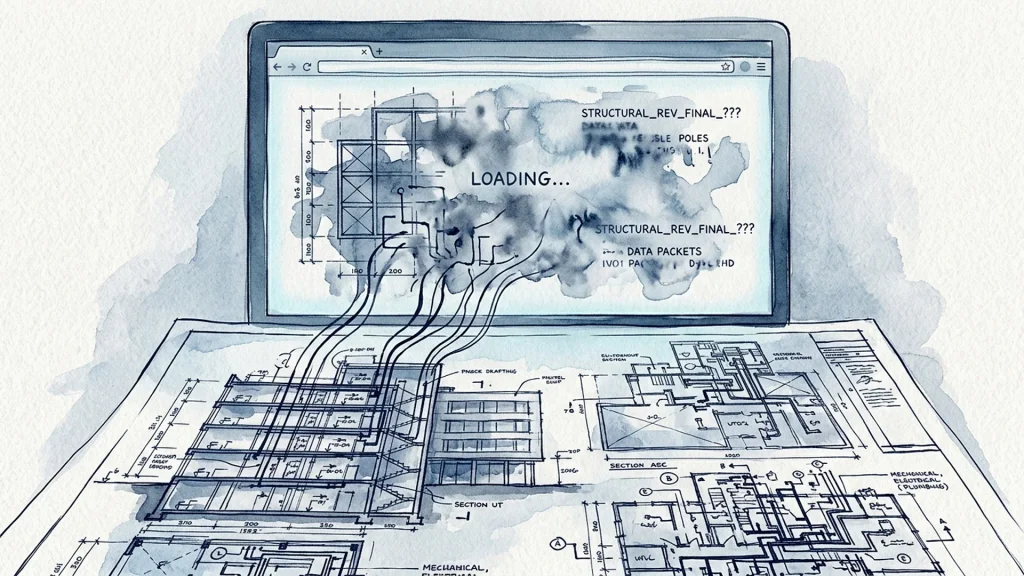
Your firm has navigated complex lateral load conditions, designed MEP systems for mission-critical facilities under brutal schedule pressure, and made judgment calls that saved projects millions. Yet visit your website, and here’s what a selection committee actually reads: “We deliver innovative, client-focused engineering solutions.” That gap between the technical credibility you’ve earned and the generic language your website broadcasts is exactly why technically superior firms keep losing shortlist placements to weaker competitors.
This foundational challenge sits at the heart of our broader guide on marketing for engineering firms: how to turn technical expertise into a website that wins work and talent. Engineering firm brand messaging too often strips out the very substance that makes a firm worth hiring. Risk-averse cultures, generalist agencies without AEC fluency, and the mistaken belief that clients can’t handle technical content all drive firms toward dangerously vague positioning. The cost shows up directly in missed shortlists!
Why Engineering Firms Strip Technical Depth from Their Brand Messaging
- Risk-averse cultures default to generic language, treating technical precision as a liability
- Generalist design agencies apply corporate templates that erase AEC differentiation
- A false belief that non-engineer decision-makers can’t absorb technical substance drives oversimplification
- Trying to appeal to everyone produces messaging that resonates with no one
- Fragmented internal messaging governance confuses selection committees and dilutes credibility
Engineering firms are built on precision, yet their brand messaging often abandons that precision entirely. Risk-averse cultures condition teams to soften technical claims, fearing misstatements or perceived liability. The result? Capabilities that took decades to build get reduced to phrases like “innovative solutions” and “client-focused delivery.” That’s not differentiation. That’s noise!
The problem compounds when firms hire generalist agencies with no AEC industry experience. Those agencies reach for corporate professional-services templates, producing vague value propositions that could describe a law firm or an accounting group. Technical depth in AEC website copy, your real competitive advantage, disappears in the translation. However, the most damaging misconception is this: that developers, facility directors, and procurement committees don’t value technical substance. In reality, strong technical depth in AEC website copy signals competence and builds trust with exactly those decision-makers.
Finally, when BD (business development), marketing, and operations each use different language, selection committees encounter a fragmented brand. No one can identify your point of view. For more on how competitors are closing this gap, see what a $50M engineering firm can learn from how top competitors position themselves online!
The Cost of Generic Engineering Company Value Proposition Language
- Vague phrases make structural, MEP, and civil firms indistinguishable, forcing selection committees to default to price or relationships
- Generic messaging fails both technical evaluators and business-side decision-makers simultaneously
- Senior engineering recruits see no evidence of technical depth and choose firms that clearly articulate their judgment
- Without visible technical differentiation, firms surrender premium positioning and margins they’ve genuinely earned
Walk through ten competing engineering firm websites right now. You’ll find the same phrases repeated almost word-for-word: “innovative solutions,” “client-focused approach,” “full-service capabilities.” This language isn’t just forgettable; it’s actively damaging your engineering firm brand messaging strategy. When every firm sounds identical, selection committees have no rational basis for differentiation. They default to price or existing relationships.
Here’s what makes this especially costly: selection committees aren’t just engineers. Developers and institutional owners understand technical complexity, but they need it translated into business context. Generic B2B engineering firm website messaging fails both the technical evaluators and the business-side decision-makers simultaneously. Recruiting compounds the damage further. Senior engineers want evidence of serious technical judgment before they apply. When your website reads like a brochure, experienced talent moves toward firms whose content framework positions engineers as genuine thought leaders.
The absence of a structured engineering company value proposition framework is often the root cause. Without it, every department fills the vacuum with its own language, and the result is a brand that feels inconsistent, uncertain, and unconvincing to the selection committees you’re trying to impress.
A Technical Depth Messaging Framework for Engineering Firms
- Lead with business outcome, layer in technical approach, then anchor with proof
- Discipline-specific language translates complex capabilities into client value
- Bridge technical and business audiences without sacrificing either
- Clarity signals credibility, not simplification
The most effective engineering company value proposition framework follows a deliberate hierarchy: start with the business outcome your client cares about, layer in the technical approach that makes your judgment distinct, then support everything with proof. This sequence respects both the facility director and the structural engineer sitting on the same selection committee!
Discipline-specific translation makes this framework come alive for structural, MEP, and civil engineering positioning. Structural firms can explain load path optimization not as an abstract achievement, but as a decision that reduced steel tonnage and protected the construction schedule. MEP firms can position integrated systems thinking as active risk mitigation, meaning fewer RFIs (requests for information) and fewer change orders. Civil firms can frame resilience engineering as long-term infrastructure value protecting an owner’s capital investment for decades.
Each translation preserves technical depth in AEC website copy while connecting directly to what clients measure. The key is bridging language: use precise technical terms, then immediately contextualize them. “Redundant structural systems reduce construction risk and change orders” speaks to both audiences in one sentence. This approach is central to strong structural, MEP, and civil engineering positioning, and it’s what separates firms that win shortlists from firms that wonder why they keep losing them!
Before and After: What Better Messaging Actually Looks Like
Consider a mid-market MEP firm competing for a hospital expansion project. Their original website headline read: “Comprehensive MEP engineering solutions for complex facilities.” Generic, forgettable, and indistinguishable from every competitor on the shortlist.
After applying a structured messaging framework, their positioning became: “We design integrated MEP systems for active healthcare facilities, coordinating around infection control requirements and phased occupancy to keep your project on schedule and your patients safe.” That single sentence communicates sector expertise, technical judgment, and client-side risk awareness, all at once!
The result was immediate. Selection committee feedback shifted from “strong credentials” to “clearly understands our environment.” The firm advanced to interviews on two consecutive hospital pursuits they had previously lost at the RFQ (request for qualifications) stage. That’s the measurable impact of getting your technical depth in AEC website copy right.
Pressure-Testing Your Messaging with Clients and Selection Committees
- Validate draft messaging directly with three to five existing clients
- Interview selection committee members from recent pursuits
- A/B test positioning language across your website and proposals
- Build messaging governance across all firm communications
The fastest way to sharpen your engineering firm brand messaging strategy is to stop guessing and start asking! Share draft positioning with three to five existing clients and ask one direct question: does this accurately reflect how we solved your problem and why you chose us? Their answers will almost always reveal language far more compelling than what your internal team produced.
Go further by interviewing selection committee members from recent pursuits. Ask what technical language signals credibility in your discipline. Their vocabulary becomes your messaging vocabulary. Next, A/B test that refined language on your website and in proposals. Track which positioning phrases appear in shortlist notifications and RFP (request for proposal) feedback. Real pursuit data beats internal opinion every time.
Consequently, build a messaging governance process. Inconsistent positioning across your website, proposals, and recruiting materials signals weak brand discipline. Consistency isn’t just polish; it’s proof of organizational confidence. Closing the gap between internal perception and external impact is the core challenge covered in our broader guide on marketing for engineering firms: how to turn technical expertise into a website that wins work and talent.
Your Technical Depth Deserves a Website That Matches It
Engineering firms lose technical credibility online for one core reason: they strip away the very substance that makes them worth hiring. Generic value propositions, risk-averse language, and brochure-style websites leave selection committees unable to distinguish your firm from the next one on the shortlist.
The fix is strategic, not cosmetic. A structured engineering company value proposition framework, built around discipline-specific language, real technical judgment, and pressure-tested positioning, transforms your website into a genuine business development asset. Better project pages, stronger recruiting content, and sharper pursuit collateral all depend on getting your messaging right first. Structural, MEP, and civil engineering positioning that actually reflects your capabilities gives selection committees the clarity they need to choose you.
Your expertise is exceptional. Let’s make sure your website finally proves it!