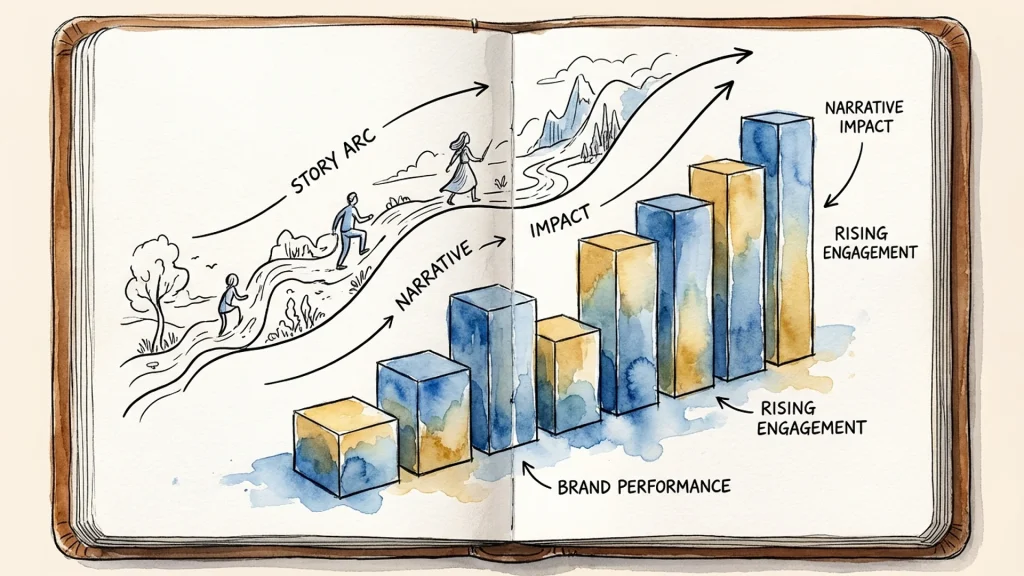
Why Your Brand Story Needs a Scorecard
You’ve invested in premium storytelling. Your website now features compelling narratives, authentic brand messaging, and carefully crafted content that speaks directly to your ideal customers. But here’s the million-dollar question: Is it actually working? For Marketing Directors and Founders of challenger brands in construction, industrial, and B2B services, storytelling isn’t just creative expression—it’s a strategic investment that must deliver measurable business results! Without proper metrics and evaluation frameworks, you’re essentially flying blind, unable to justify your investment or optimize your approach. This article dives deep into the specific methods and metrics you need to evaluate storytelling effectiveness and prove its impact on brand performance, an essential component of our complete guide to Strategic web design.
Establishing Your Baseline Performance Metrics
- Document current brand awareness levels and market position
- Record existing conversion rates across all customer touchpoints
- Measure current customer acquisition costs and lifetime value
- Assess brand perception through surveys and competitive analysis
Before you can measure storytelling impact, you absolutely must establish your baseline! This means documenting where your brand stands right now, before implementing or refining your narrative strategy. For challenger brands competing against established market leaders, this baseline becomes your reference point for demonstrating progress and justifying continued investment in premium narrative design.
Start by conducting a comprehensive brand audit that captures both quantitative and qualitative data. Survey your existing customers about brand perception, awareness, and emotional connection. Document your current market position relative to competitors—are you truly that #3 or #4 player looking to overtake the leader? Record your website analytics, including traffic sources, bounce rates, time on site, and conversion paths. This data provides the foundation for measuring change over time.
Furthermore, establish clear financial benchmarks. What’s your current customer acquisition cost? What’s the average deal size? How long does your sales cycle typically run? These numbers will prove invaluable when demonstrating how strategic storytelling impacts your bottom line. Many mid-market companies skip this crucial step and later struggle to prove ROI because they lack comparison data. Don’t make that mistake!
Tracking Engagement Metrics That Actually Matter
- Monitor time-on-page and scroll depth for narrative content
- Track video completion rates and interactive element engagement
- Analyze repeat visitor behavior and content consumption patterns
- Measure social sharing and organic brand mentions
Not all engagement metrics carry equal weight! While vanity metrics like page views might make you feel good, they don’t necessarily indicate that your storytelling is resonating with your target audience. Instead, focus on behavioral signals that demonstrate genuine interest and emotional connection. For B2B challenger brands, quality of engagement trumps quantity every single time.
Time-on-page becomes particularly revealing for narrative-driven content. If visitors are spending three to five minutes reading your brand story or case studies, that suggests genuine engagement rather than quick scanning. Scroll depth tracking shows whether people are consuming your entire narrative or bouncing after the first paragraph. These metrics help you understand which stories resonate and which fall flat.
Video completion rates offer another powerful indicator of storytelling effectiveness. When Marketing Directors watch 80% or more of your brand story video, they’re demonstrating serious interest. Similarly, track how visitors interact with interactive elements like calculators, assessments, or configurators embedded within your narrative framework. High engagement with these tools suggests your storytelling is successfully moving prospects toward conversion.
Pay special attention to repeat visitor behavior. When the same individuals return multiple times to consume additional content, it indicates your narrative is building momentum and trust. This pattern is especially common in B2B sales cycles where decision-makers need multiple touchpoints before committing to premium investments. As discussed in The ROI of Premium Narrative Design: Why It Matters for Challenger Brands, these engagement patterns directly correlate with higher-value partnerships.
Measuring Brand Perception Shifts
- Conduct quarterly brand perception surveys with target audiences
- Monitor changes in brand attribute associations
- Track sentiment analysis across digital channels
- Measure aided and unaided brand recall improvements
Here’s where storytelling shows its true power—in shifting how your market perceives your brand! For challenger brands in unsexy industries, this transformation from “embarrassing digital presence” to “premium market player” represents massive competitive advantage. However, measuring perception requires systematic, ongoing research rather than one-time snapshots.
Implement quarterly brand perception surveys targeting your ideal customer profile. Ask specific questions about brand attributes: Do they perceive you as innovative or traditional? Premium or budget? Strategic partner or vendor? Track how these associations evolve after implementing narrative-driven content. The goal isn’t just awareness—it’s positioning yourself as the obvious choice for companies seeking transformative results rather than commodity services.
Sentiment analysis tools can monitor how people discuss your brand across social media, review sites, and industry forums. Are conversations becoming more positive? Are people using language that reflects your desired positioning? This qualitative data complements quantitative metrics and reveals whether your narrative is resonating emotionally with your target audience.
Connecting Storytelling to Revenue Performance
- Track changes in average deal size and project value
- Monitor improvements in sales cycle length
- Measure lead quality scores and conversion rates by source
- Calculate customer lifetime value changes over time
Let’s talk about what really matters—revenue impact! For challenger brands investing $40,000 to $80,000 in premium narrative design, demonstrating clear financial returns isn’t optional. Your storytelling must drive business results, period. The good news? When done strategically, narrative-driven approaches deliver measurable improvements across multiple revenue metrics.
Start tracking average deal size before and after implementing strategic storytelling. Many agencies report that premium narrative positioning naturally attracts higher-value clients while disqualifying price shoppers. If your average project value increases from $15,000 to $45,000, that’s directly attributable to positioning shifts created through storytelling! This single metric can justify entire investments in narrative strategy.
Sales cycle length provides another crucial indicator. When prospects arrive pre-educated through compelling narrative content, they typically move through decision-making faster. Track how long it takes leads from different sources to close. Leads who’ve engaged deeply with your storytelling often close 30-40% faster because they’ve already built trust and understanding through your narrative.
Implement lead scoring systems that account for content engagement. Assign higher scores to prospects who consume multiple pieces of narrative content, watch brand story videos, or download case studies. Then track how these higher-scored leads convert compared to those with minimal engagement. This data demonstrates storytelling’s role in generating qualified pipeline rather than just traffic.
Evaluating Competitive Positioning Gains
- Monitor market share changes within target segments
- Track win rates against specific competitors
- Measure improvements in RFP invitation rates
- Assess changes in industry recognition and awards
For challenger brands, the ultimate measure of storytelling success is competitive advancement! Are you actually overtaking that market leader? Are you winning deals you previously lost? These competitive metrics reveal whether your narrative strategy is delivering on its core promise—helping you punch above your weight class.
Track your win rates in competitive situations, particularly against the #1 and #2 players in your market. When your storytelling effectively differentiates your approach and value proposition, you should see improved performance in head-to-head competitions. Document specific deals where narrative content played a role in your selection. Collect feedback from won and lost opportunities to understand how your story influenced decision-making.
Monitor whether you’re being invited to more strategic conversations and RFPs. Premium storytelling positions you as a thought leader rather than a commodity provider. This shift often manifests as invitations to participate in higher-value opportunities that previously went only to established leaders. Similarly, track industry recognition, speaking invitations, and media mentions—all indicators that your narrative is elevating your market position. The integration of compelling storytelling with High-End Visual Design: Creating a Memorable Brand Presence Online creates particularly powerful competitive differentiation.
Implementing Continuous Measurement Systems
- Establish monthly reporting dashboards for key metrics
- Create quarterly business reviews connecting narrative to outcomes
- Develop attribution models for storytelling touchpoints
- Build feedback loops for continuous narrative optimization
Measurement can’t be a one-time exercise—it requires ongoing systems and processes! Successful challenger brands implement continuous measurement frameworks that track storytelling impact across multiple timeframes and touchpoints. This systematic approach enables rapid optimization and provides the data needed to justify continued investment in narrative strategy.
Create comprehensive dashboards that update monthly with your core storytelling metrics. Include engagement data, perception shifts, revenue indicators, and competitive positioning markers. Make these dashboards accessible to leadership so everyone understands how narrative strategy contributes to business performance. Transparency builds internal support for premium storytelling investments.
Develop attribution models that account for storytelling’s role in the customer journey. Most B2B buyers consume multiple pieces of content across several touchpoints before converting. Multi-touch attribution reveals how narrative content influences decisions throughout the funnel, not just at final conversion. This holistic view prevents undervaluing storytelling’s contribution to revenue generation.
Transform Your Brand Performance Through Measured Storytelling
Measuring storytelling impact isn’t just about proving ROI—it’s about optimizing your narrative strategy to drive continuous improvement in brand performance! By establishing clear baselines, tracking meaningful engagement metrics, monitoring perception shifts, connecting narrative to revenue, evaluating competitive gains, and implementing systematic measurement frameworks, you create a data-driven approach to storytelling that delivers exceptional results. For challenger brands in construction, industrial, and B2B services, this measurement discipline separates strategic narrative investments from creative experiments. The metrics don’t lie—premium storytelling, when properly implemented and measured, consistently outperforms generic content approaches in attracting high-value partnerships and advancing market position. Ready to transform your measurement approach and unlock the full potential of strategic storytelling? Your competitors are already investing in narrative strategy—the question is whether you’ll measure its impact effectively enough to gain competitive advantage!
Frequently Asked Questions
Storytelling creates emotional connections with audiences, enhancing brand recall and loyalty. By engaging customers through relatable narratives, brands can significantly improve their performance, driving higher conversion rates and fostering long-term relationships.
You can measure storytelling impact by evaluating brand awareness, tracking engagement metrics like likes and shares, and analyzing conversion rates. These metrics help gauge how well your story resonates with audiences and contributes to achieving business goals.
Essential metrics include brand awareness and reach, engagement levels (likes, shares, comments), and conversion rates. Additionally, monitoring Customer Acquisition Cost (CAC) can provide insights into the effectiveness of your storytelling strategies and overall ROI.
Challenger Brands should focus on defining authentic narratives, utilizing high-end visual design, and aligning their storytelling with business goals. These strategies can help differentiate the brand and create compelling stories that resonate with target audiences.
Narrative design is crucial for ROI as it helps attract the right audience, reduces Customer Acquisition Costs, and increases conversion rates. A well-crafted narrative aligns with business objectives, ensuring that every storytelling element supports overall brand success.
Avoid generic or inauthentic narratives that don’t resonate with your audience. Additionally, failing to align storytelling efforts with business goals can dilute your message and hinder brand performance. Focus on authenticity and consistency for the best results.
Storytelling enhances customer loyalty by creating emotional connections that make audiences feel part of the brand’s journey. When customers relate to a brand’s story and values, they are more likely to stay engaged and become repeat supporters.