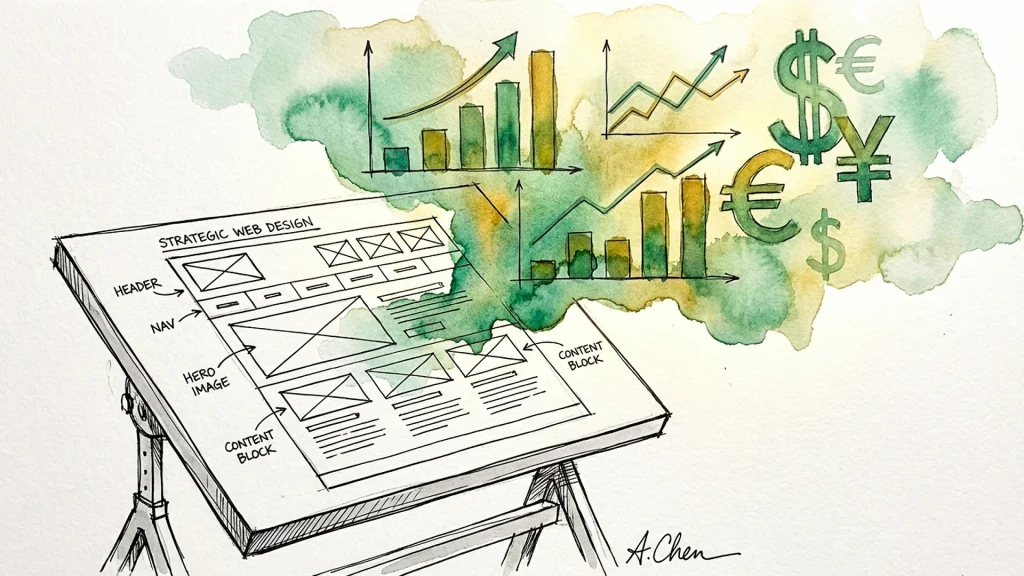
Why Your Website Should Be Your Hardest-Working Salesperson
Here’s something that keeps marketing directors up at night: your competitors with inferior products are closing deals you should be winning. Why? Because their website tells a better story and guides prospects to conversion with ruthless efficiency! While you’re investing in trade shows, sales training, and marketing campaigns, your digital storefront might be actively repelling the high-value clients you’re trying to attract. For challenger brands in industrial sectors, construction, and B2B services, this isn’t just frustrating—it’s expensive.
Strategic web design isn’t about making things look pretty. It’s about architecting a digital experience that converts visitors into qualified leads and ultimately drives measurable revenue growth. When executed correctly, your website becomes a 24/7 sales machine that qualifies prospects, communicates value, and moves buyers through your funnel without requiring constant human intervention. This is the foundation of our complete guide to strategic web design, where we explore how challenger brands can leverage design as a competitive weapon rather than treating it as a cosmetic afterthought.
The Revenue Architecture Behind High-Converting Websites
- Conversion pathways that align with actual buyer psychology
- Strategic information hierarchy that answers objections before they arise
- Visual design elements that build credibility and trust instantly
- Navigation structures that guide different buyer personas to relevant content
Revenue-focused web design starts with understanding that your website isn’t a brochure—it’s a sophisticated sales tool. Every element, from your hero section to your footer, should serve a specific purpose in moving prospects closer to a buying decision. This requires thinking beyond aesthetics and diving deep into conversion psychology.
The most effective websites for mid-market companies create distinct pathways for different visitor types. Your CFO researching solutions has different needs than the operations manager who’ll actually use your service. Strategic design acknowledges these differences and creates tailored experiences that speak directly to each stakeholder’s concerns. This isn’t about creating separate websites; it’s about intelligent information architecture that adapts to user intent.
Consider how premium brands in consumer markets handle this challenge. Companies like Patagonia don’t just sell products—they sell values, stories, and outcomes. Their websites guide visitors through narratives that build emotional connection while simultaneously providing the rational justification buyers need. Challenger brands in “unsexy” industries can apply these same principles! Your construction technology or industrial services might not seem glamorous, but the transformation you deliver absolutely is.
Conversion Optimization That Actually Moves the Revenue Needle
- Strategic placement of social proof that addresses specific objections
- Call-to-action hierarchy that qualifies leads while encouraging engagement
- Content depth that demonstrates expertise without overwhelming visitors
- Performance optimization that prevents revenue loss from slow load times
Traditional conversion rate optimization focuses on incremental improvements—changing button colors, tweaking headlines, adjusting form fields. While these tactics matter, they’re tactical adjustments within a potentially flawed strategy. Revenue-focused design starts by asking fundamental questions: Are we attracting the right visitors? Does our value proposition resonate with decision-makers who have budget authority? Are we inadvertently appealing to price shoppers instead of value buyers?
For challenger brands targeting that $40k to $80k project range, your website must actively disqualify low-value prospects while rolling out the red carpet for qualified buyers. This seems counterintuitive—why would you want fewer leads? Because not all leads are created equal! A hundred $5k inquiries create more work, more disappointment, and less revenue than ten $50k opportunities from buyers who understand the value of premium solutions.
Strategic conversion optimization means being explicit about your positioning. If you’re competing on value rather than price, your website should make this abundantly clear from the first interaction. This doesn’t mean being arrogant or exclusionary; it means confidently communicating who you serve best and what makes your approach different. When the ROI of premium narrative design is properly communicated, qualified prospects actually appreciate the clarity because it helps them determine fit quickly.
Design Elements That Build Trust and Accelerate Sales Cycles
- Visual sophistication that matches the quality of your actual work
- Case studies structured around outcomes rather than features
- Team presentations that emphasize expertise and accessibility
- Process transparency that reduces perceived risk
Marketing directors in mid-market companies face a unique challenge: their work quality often far exceeds their digital presence. You deliver exceptional results, but your website looks like it was built in 2012 by someone’s nephew. This disconnect creates cognitive dissonance for prospects. If you can’t invest in your own digital presence, why should they trust you with theirs?
High-end visual design isn’t vanity—it’s risk mitigation for your prospects. When buyers are evaluating $40k to $80k investments, they’re looking for signals that you’re stable, professional, and capable of delivering on promises. Your website is often their first impression, and research consistently shows that users form judgments about credibility within milliseconds of landing on a page. You don’t get a second chance to make that first impression!
However, visual polish alone isn’t enough. The most effective revenue-driving websites combine sophisticated aesthetics with strategic content that addresses the specific concerns of risk-averse B2B buyers. This means showcasing your process, making your team accessible, and providing transparent information about timelines, methodologies, and expected outcomes. When prospects can visualize working with you before they ever schedule a call, you’ve dramatically shortened your sales cycle.
Consider how you present case studies. Most companies list features and deliverables: “We built a website with 50 pages, integrated their CRM, and provided training.” Yawn! Revenue-focused case studies tell transformation stories: “Our client was losing deals to competitors with inferior products but better digital presence. Within six months of launching their new strategic website, their close rate increased by 34% and their average deal size grew by $12k.” See the difference? One describes what you did; the other demonstrates the value you created.
Navigation and Information Architecture as Sales Tools
- Menu structures that guide visitors to high-value conversion points
- Content organization that mirrors the buyer’s journey
- Strategic internal linking that keeps prospects engaged
- Clear pathways for different decision-maker roles
Navigation seems like a mundane technical detail, but it’s actually one of your most powerful sales tools. How you organize information signals what you value and guides visitors toward specific outcomes. Poor navigation creates friction and confusion; strategic navigation creates momentum toward conversion.
Think about your typical buyer’s journey. They don’t arrive at your website ready to request a proposal. They’re researching, comparing, and trying to determine if you’re even in the right ballpark. Your navigation should acknowledge this reality by providing clear pathways for different stages of awareness. Someone in early research needs different information than someone ready to evaluate vendors.
The most effective approach creates intuitive categories while strategically highlighting your differentiators. Instead of generic “Services” and “About” pages, consider navigation that speaks to outcomes: “Revenue Growth Solutions,” “Our Process,” “Client Transformations.” This subtle shift reframes the conversation from what you do to what prospects achieve by working with you.
Measuring What Actually Matters for Revenue Growth
- Lead quality metrics beyond simple volume counts
- Engagement patterns that predict conversion likelihood
- Revenue attribution that connects design to business outcomes
- Iterative optimization based on actual sales data
You can’t improve what you don’t measure, but most companies track the wrong metrics. Page views, bounce rates, and time on site provide interesting data, but they don’t directly correlate with revenue. Strategic web design requires connecting digital metrics to business outcomes.
Start by defining what a qualified lead actually looks like for your business. For challenger brands targeting mid-market companies, this might include company size, industry, role of the inquirer, and specific language used in their initial contact. Track these characteristics over time and you’ll start seeing patterns. Which website pathways generate the highest-quality leads? Which content pieces appear most frequently in the journey of prospects who become clients?
This data-driven approach allows you to continuously refine your website’s revenue-generating capabilities. Perhaps you discover that prospects who read your methodology page before requesting a consultation close at twice the rate of those who don’t. That insight should inform how you guide visitors through your site! Maybe you find that video testimonials from clients in specific industries dramatically increase conversion for similar prospects. Double down on creating more of that content.
Transform Your Website Into Your Most Valuable Sales Asset
Your website should be working as hard as your best salesperson—qualifying prospects, communicating value, addressing objections, and moving buyers toward decisions. For challenger brands competing in industrial sectors and B2B services, this isn’t optional; it’s essential for growth. When your digital presence matches the quality of your actual work, you stop losing deals to competitors with inferior offerings but superior positioning.
Strategic web design represents a fundamental shift from viewing your website as a marketing expense to recognizing it as a revenue-generating asset. This requires investment, both financial and intellectual, but the returns compound over time. Every improvement to your conversion pathways, every refinement to your messaging, every enhancement to your visual credibility continues delivering value long after implementation.
Ready to stop embarrassing yourself with a website that doesn’t reflect your capabilities? It’s time to explore high-end visual design approaches that position you as the premium choice in your market. Your competitors are already investing in strategic web design—the question isn’t whether you can afford to upgrade your digital presence, but whether you can afford not to!
Frequently Asked Questions
Strategic web design focuses on creating user experiences that drive engagement and conversions. It integrates aesthetics with functionality to help brands connect with their audience, particularly for Challenger Brands looking to outperform competitors.
Designing for revenue enhances user experience and optimizes conversion paths, which can directly increase sales. By crafting compelling calls-to-action and streamlined navigation, businesses can improve user engagement and reduce bounce rates.
Effective conversion optimization techniques include using compelling CTAs, simplifying site navigation, and implementing A/B testing. These strategies ensure that users have a seamless experience, which is pivotal in turning visitors into customers.
Consistent storytelling reinforces brand identity and builds trust with users. By maintaining a cohesive narrative across digital platforms, brands present themselves as reliable choices, particularly in crowded markets.
High-end visual design creates a memorable brand presence by aligning visual elements with brand messaging. For Challenger Brands, unique and consistent designs help differentiate them from competitors and foster user loyalty.
Brands should avoid prioritizing aesthetics over usability, neglecting mobile optimization, and failing to conduct user testing. These mistakes can harm user experience and negatively impact conversion rates.
Brands should assess their current web design for user experience and conversion optimization opportunities. Engaging with experts in strategic web design can provide tailored solutions that align with their specific goals.