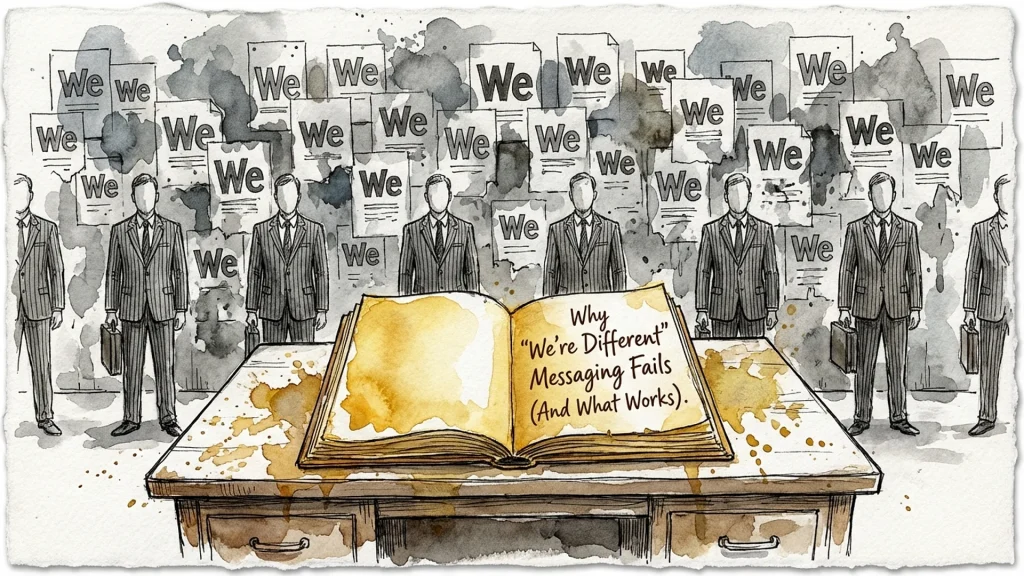
Your homepage declares you’re “the leading provider of innovative solutions.” Your competitor’s site says they’re “the industry’s most trusted partner delivering cutting-edge technology.” And the company next door? They’re “transforming businesses with best-in-class expertise.” Here’s the uncomfortable truth: your prospects can’t tell any of you apart! In saturated B2B markets, differentiation messaging has become a homogenized blur of superlatives and feature claims that sound identical across competitors. When everyone claims to be different, no one is memorable. The problem isn’t that you lack differentiation, it’s that your narrative positioning strategy saturated markets approach is failing to communicate what actually makes you unique. Instead of telling prospects you’re different, you need to show them through story-driven brand messaging competitive advantage that creates genuine distinction!
The Differentiation Paradox in Saturated Markets
Let’s address the elephant in the room: B2B differentiation without feature claims seems impossible when you’re competing in crowded markets where everyone offers similar capabilities. Marketing directors face enormous pressure to articulate what makes their company special, so they default to the same playbook: list features, add superlatives, claim superiority. The result? A sea of indistinguishable messaging that prospects scroll past without a second thought.
Consider what happens when a potential client researches solutions in your category. They visit five websites, and each one promises faster implementation, better results, and superior service. Without concrete evidence or distinctive narratives, these claims become white noise. Research shows that decision-makers spend an average of just 54 seconds on a B2B website before bouncing, and generic differentiation claims are a primary culprit. Your prospects aren’t questioning whether you’re good at what you do; they’re struggling to remember which company said what!
The real challenge isn’t creating differentiation, it’s making it memorable and believable. Features can be copied, superlatives can be claimed by anyone, but your story cannot be replicated. This is where understanding how to stand out in crowded B2B markets requires a fundamental shift from claim-based positioning to narrative-based positioning. When you grasp this distinction, everything changes!
Why Feature-Based Differentiation Creates Commoditization
Feature-based differentiation actually accelerates commoditization rather than preventing it. When you lead with capabilities, you invite direct comparison on the very dimensions where competitors can most easily match or exceed you. Faster processing? Someone will claim faster. More integrations? Another company will add more. Better customer service? Everyone says that!
The commoditization trap deepens when sales teams rely on these feature-based differentiators in conversations. Sales cycles extend because prospects need to conduct exhaustive comparisons across multiple vendors, building spreadsheets that reduce your unique value to checkboxes and pricing columns. When everything looks similar on paper, price becomes the deciding factor. You’ve inadvertently positioned yourself as a commodity!
Breaking free requires embracing commercial narrative design: how story-driven websites shorten sales cycles and command premium pricing that shifts the conversation entirely. Instead of competing on features, you compete on perspective, philosophy, and approach. This is the foundation of sustainable competitive advantage!
The Three Narrative Angles That Create Differentiation
Effective story-driven brand messaging competitive advantage emerges from one of three narrative frameworks: the origin story, the methodology narrative, or the transformation philosophy. Each creates differentiation by showing rather than telling, by revealing the thinking behind what you do rather than just describing what you do. Let’s explore how each framework works!
The Origin Story Framework
Your narrative angle origin story methodology framework begins with why your company exists in the first place. What problem did the founder encounter that existing solutions couldn’t solve? What frustration or insight sparked the creation of your approach? Origin stories create differentiation because they’re inherently unique and they establish credibility through lived experience rather than marketing claims.
Consider a cybersecurity firm founded by a former hacker who witnessed the inadequacy of traditional security measures. Their origin story isn’t “we provide comprehensive security solutions,” it’s “we think like attackers because we were attackers, and that perspective reveals vulnerabilities others miss.” This narrative immediately differentiates them without making a single feature claim. The story itself is the differentiation!
The Methodology Narrative
The methodology narrative articulates your distinctive process or approach. Rather than claiming you’re better, you demonstrate how you think differently about solving problems. This framework works exceptionally well for professional services firms and consultancies where the intellectual property is the process itself.
A management consulting firm might position around “the three-horizon transformation model” that addresses immediate operational needs, medium-term capability building, and long-term strategic positioning simultaneously. They’re not claiming to be “the best consultants,” they’re teaching a framework that demonstrates their thinking. Prospects remember the framework, associate it with the firm, and understand the value before any sales conversation begins. That’s powerful differentiation!
The Transformation Philosophy
The transformation philosophy narrative focuses on the change you believe needs to happen in your industry or in how clients approach their challenges. This positions your company as a thought leader with a point of view, not just a service provider. You’re inviting prospects into a movement, not just a transaction.
An HR technology company might position around the philosophy that “employee engagement can’t be measured with annual surveys; it requires continuous conversation and real-time sentiment analysis.” This philosophical stance differentiates them from competitors still selling traditional survey tools. Prospects who resonate with this belief become qualified leads because they share the underlying philosophy!
Implementing Narrative Positioning Strategy
Understanding the framework is one thing; implementation is where most companies struggle. Transitioning from claim-based to narrative-based positioning requires auditing your current messaging, identifying your authentic narrative angle, and systematically integrating it across all customer touchpoints. This isn’t about adding a founder’s story to your About page; it’s about making narrative the organizing principle of your entire brand communication!
Start by conducting a competitive messaging audit. Visit your top five competitors’ websites and document their value propositions, taglines, and key differentiators. You’ll likely notice striking similarity in language and claims. This exercise reveals the opportunity: the narrative space that no one else is occupying. What story could you tell that would be impossible for competitors to replicate because it’s rooted in your specific experience, methodology, or philosophy?
Next, mine your company’s history and expertise for narrative gold. Interview founders, long-tenured employees, and satisfied clients. Ask questions like: “What problem were we originally trying to solve?” “What do we believe about this industry that others don’t?” “What’s our approach that clients comment on most frequently?” The answers reveal your authentic narrative angle. Authenticity is crucial because manufactured stories feel hollow and undermine trust!
Once you’ve identified your narrative angle, integrate it systematically. Your homepage should lead with the narrative, not feature lists. Your service pages should explain your approach through the lens of your methodology or philosophy. Case studies should demonstrate your transformation philosophy in action. For guidance on translating complex services into compelling narratives, explore from jargon to journey: translating complex B2B services into stories prospects actually understand.
Beyond Differentiation: Narrative as Strategic Asset
The ultimate power of narrative positioning extends beyond mere differentiation. When executed well, your narrative becomes a strategic asset that compounds over time. Educational content builds around your framework. Speaking opportunities emerge from your distinctive philosophy. Media coverage positions you as a thought leader rather than just another vendor. Your narrative becomes the foundation for thought leadership, content marketing, and brand authority!
This compounding effect explains why narrative positioning creates sustainable competitive advantage while feature-based differentiation remains perpetually vulnerable. Features can be copied within months; a well-established narrative takes years to build and cannot be replicated. Your origin story is yours alone. Your methodology reflects accumulated expertise and intellectual property. Your transformation philosophy represents a stake in the ground that attracts aligned clients and repels misaligned ones.
Furthermore, narrative positioning enables premium pricing in ways that feature parity never can. Prospects don’t price-shop philosophies; they buy into them or they don’t. When someone resonates with your narrative, price becomes secondary to alignment. They’re not comparing your hourly rate to competitors; they’re evaluating whether your approach matches their needs and values. This fundamentally changes the sales dynamic in your favor!
Consider implementing the CEO’s website audit: 10 questions that reveal if your site builds authority or undermines it to evaluate whether your current digital presence supports or undermines your narrative positioning strategy. Often, small messaging adjustments create dramatic improvements in differentiation!
Your Narrative Differentiation Starts Now
Standing out in saturated B2B markets doesn’t require inventing revolutionary features or making bolder claims than your competitors. It requires articulating your unique narrative angle with clarity and consistency! Whether you build differentiation through your origin story, your methodology narrative, or your transformation philosophy, the key is shifting from telling prospects you’re different to showing them through story-driven brand messaging that creates genuine competitive advantage.
The companies that win in crowded markets aren’t necessarily those with superior capabilities; they’re the ones prospects remember, understand, and trust. Narrative positioning creates that memorability by tapping into how human brains actually process and retain information. We’re wired for stories, not feature lists. We remember philosophies, not superlatives. We connect with authentic experiences, not marketing claims!
Stop asking “how are we different?” and start asking “what’s our story?” That shift in perspective unlocks differentiation that competitors cannot replicate and prospects cannot forget. Your narrative positioning strategy becomes the foundation for everything else: your messaging, your content, your sales approach, and ultimately, your market position. In saturated markets, the companies that master narrative positioning don’t just survive, they dominate their category by creating an entirely new conversation that they alone can lead!
Frequently Asked Questions
When every competitor claims to be innovative, trusted, or cutting-edge, these superlatives become indistinguishable noise. Prospects spend an average of just 54 seconds on B2B websites before bouncing, and generic differentiation claims don’t stick in their memory. The problem isn’t that you lack differentiation—it’s that narrative positioning strategy in saturated markets requires showing your uniqueness through stories rather than telling prospects you’re different through feature lists.
Feature-based differentiation invites direct comparison on dimensions where competitors can easily match or exceed you, accelerating commoditization rather than preventing it. When you lead with capabilities like faster processing or more integrations, you’re competing on a playing field where everyone can claim the same advantages. Story-driven brand messaging creates competitive advantage by highlighting what cannot be replicated: your unique origin story, methodology, or transformation philosophy.
Traditional differentiation relies on claims and superlatives that sound identical across competitors, while narrative positioning uses your unique story to create memorable distinction. Narrative-based positioning shows prospects who you are, how you think, and why you do what you do—making you memorable and believable in ways that feature lists cannot. This approach to B2B differentiation without feature claims transforms your website into a pre-qualification tool that aligns with how prospects naturally process information.
The three primary narrative angles are: your origin story (why you started and what problem you saw), your methodology narrative (how you uniquely approach solving client challenges), and your transformation philosophy (what you believe about change and results). Each angle provides a different entry point for prospects to understand what makes you genuinely different. Choosing the right narrative angle depends on which story is most authentic to your company and most relevant to your target audience’s pain points.
Research shows decision-makers spend only 54 seconds on average on B2B websites before deciding whether to stay or bounce. This means your narrative positioning strategy must communicate your unique value within the first few seconds through compelling story elements rather than lengthy feature lists. When you use story-driven brand messaging, you capture attention and create differentiation in the time prospects are actually willing to invest.
Your origin story, methodology, and transformation philosophy are rooted in your actual company history, values, and experience—they cannot be replicated by competitors without being inauthentic. While features can be copied and superlatives can be claimed by anyone, your unique narrative is defensible and memorable. This is why story-driven brand messaging creates lasting competitive advantage in saturated markets where feature-based claims have become commoditized.
Instead of claiming you’re different, show prospects through narrative positioning how you think differently about their problems. Use your origin story, unique methodology, or transformation philosophy to demonstrate your perspective. This narrative-driven approach to how to stand out in crowded B2B markets transforms your messaging from generic claims into memorable stories that prospects actually remember and believe.