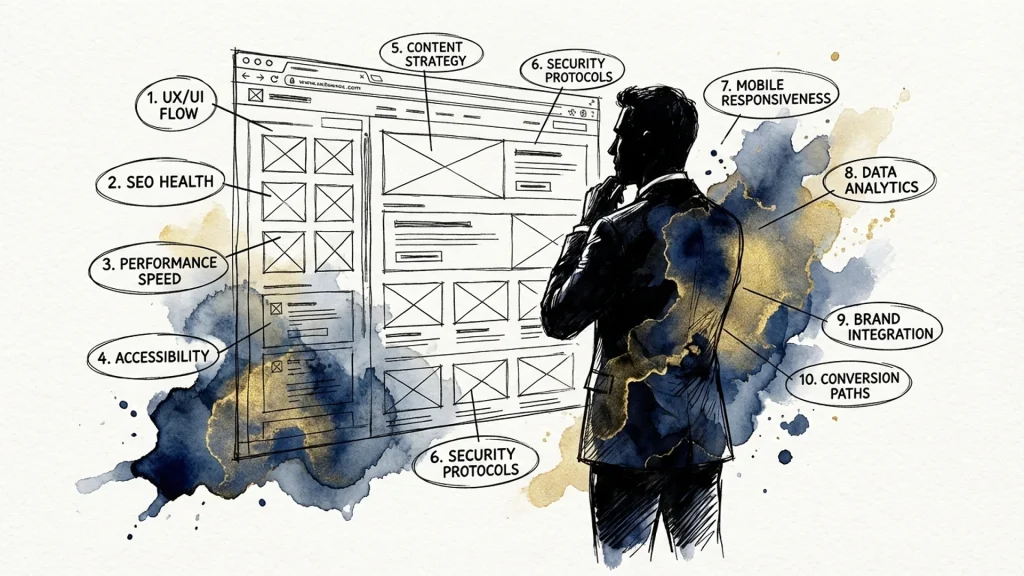
Your website isn’t just another marketing asset sitting in your digital portfolio. It’s often the first, last, and most influential touchpoint between your business and the decision-makers who can transform your revenue trajectory! Yet here’s the uncomfortable truth that keeps CEOs awake at night: many executive leaders have no objective framework for evaluating whether their website builds authority or systematically dismantles it. The difference between these two outcomes isn’t about budget or design trends. It’s about narrative coherence, strategic positioning, and whether your digital presence reflects where your company is today or where it was three years ago. This website audit checklist for executives provides a diagnostic framework that cuts through subjective opinions and reveals the hard truth about your site’s performance!
Why Traditional Website Metrics Miss the Authority Question
Most executives evaluate their websites using metrics that completely miss the point. Traffic numbers, bounce rates, and time-on-site tell you what’s happening, but they don’t reveal why prospects leave without converting or why your sales team constantly battles price objections! The real question isn’t whether people visit your site. It’s whether your website positions you as the authoritative choice in a saturated market.
Authority isn’t built through clever copywriting tricks or aesthetic polish. It emerges from narrative coherence, the strategic architecture that guides prospects through a logical journey from problem recognition to solution understanding. When your CEO website evaluation framework focuses exclusively on traditional analytics, you’re measuring activity without assessing impact. You’re counting visitors while your competitors are converting them!
The challenge becomes even more pronounced for B2B companies offering complex services. Your prospects aren’t making impulse purchases. They’re conducting extensive research, comparing multiple vendors, and building internal consensus before ever reaching out. During this invisible evaluation phase, your website either establishes your authority or confirms their suspicion that you’re just another vendor with similar capabilities. The stakes couldn’t be higher, and most executive teams don’t even realize they’re losing this battle!
Question 1: Does Your Homepage Immediately Establish Context or Create Confusion?
The moment a prospect lands on your homepage, their brain begins processing information and making snap judgments about your authority. Within seconds, they’re asking themselves: “Do these people understand my world?” Your homepage must answer this question instantly, not through claims of expertise, but through demonstrated understanding of the specific context your prospects operate within.
Authority-building websites don’t start with “We are the leading provider of…” statements. They open with recognition of the prospect’s current reality, the market pressures they face, and the strategic challenges keeping them up at night. This isn’t about pandering or fear-mongering. It’s about proving you understand their world before asking them to trust your solutions!
Look at your homepage with fresh eyes. Does it immediately orient visitors within a relevant context, or does it force them to decode your value proposition through corporate jargon and generic benefit statements? If prospects need to work to understand what you do and why it matters, you’ve already lost the authority battle. Confusion is the enemy of conversion, and ambiguity undermines credibility faster than any negative review ever could!
Question 2: Can Prospects Understand Your Differentiation Without a Sales Conversation?
Here’s a painful reality check: if your website requires a sales conversation to explain what makes you different, you don’t have a positioning problem. You have an authority crisis! Prospects researching solutions in saturated markets are actively looking for reasons to eliminate options. When your differentiation isn’t immediately apparent, you’re giving them permission to group you with every other vendor claiming similar capabilities.
The B2B website authority assessment hinges on this critical question. Authority emerges when prospects can clearly articulate your unique approach, methodology, or perspective after spending five minutes on your site. This doesn’t mean dumbing down your expertise or revealing proprietary processes. It means structuring your narrative so the logic of your differentiation becomes self-evident!
Test this yourself. Ask someone unfamiliar with your business to spend five minutes on your website, then explain back to you what makes your company different. If they struggle or resort to generic descriptors like “quality” or “customer service,” your site isn’t building authority. It’s reinforcing commodity perception, which inevitably leads to price-based competition and margin erosion. Your website should pre-qualify prospects by helping them self-identify whether your specific approach aligns with their needs and preferences!
Question 3: Does Your Site Reflect Your Current Market Position or an Outdated Version?
Companies evolve faster than their websites. You’ve refined your positioning, expanded your capabilities, and elevated your client relationships. Meanwhile, your website still reflects the company you were when you launched it three years ago! This misalignment doesn’t just create confusion. It actively undermines authority by signaling that you’re not keeping pace with market evolution.
The brand authority website audit must examine temporal alignment. Do your case studies showcase the caliber of clients you’re targeting today, or do they feature the smaller projects you completed while building your reputation? Does your language reflect the strategic conversations you’re having with C-suite buyers, or does it speak to the tactical concerns of individual contributors? Authority requires consistency between your current market position and your digital representation!
Furthermore, consider whether your website acknowledges the current competitive landscape. Markets shift, new challenges emerge, and buyer priorities evolve. If your messaging feels like it could have been written five years ago, prospects will question whether your solutions have kept pace with their changing needs. Authority isn’t static. It requires demonstrating current relevance and forward-thinking perspective, not resting on past accomplishments or outdated value propositions!
Question 4: Do Your Trust Signals Reinforce or Contradict Your Authority Claims?
Trust signals are the evidence that supports your authority claims. However, many websites inadvertently undermine their positioning through misaligned or insufficient proof points! The executive website credibility review must scrutinize whether your trust signals match the authority level you’re claiming.
If you’re positioning as an enterprise solution provider but your testimonials come from small businesses, that’s a trust signal contradiction. If you’re claiming thought leadership but your latest blog post is from eight months ago, that signals neglect rather than authority. If you’re emphasizing innovation but your case studies showcase implementations of standard practices, you’re creating cognitive dissonance that erodes credibility!
Authority-building websites carefully curate trust signals that reinforce their positioning. They showcase recognizable client logos that match their target market. They feature specific, quantifiable results rather than generic praise. They demonstrate thought leadership through regular, substantive content that advances industry conversations. Every trust signal should answer the prospect’s unspoken question: “Can I trust these people to deliver at the level they’re claiming?” When trust signals align with authority positioning, they create powerful reinforcement. When they contradict it, they raise red flags that prospects can’t ignore!
Question 5: Does Your Navigation Structure Follow Logical Narrative Flow or Internal Organization?
Most website navigation structures reflect internal organizational charts rather than the logical journey prospects need to take! Your Services menu might perfectly mirror your department structure, but does it help prospects understand the natural progression from problem to solution? This is where many B2B website authority assessments reveal critical flaws.
Authority-building websites structure navigation around the prospect’s decision-making process, not the company’s internal operations. They recognize that human brains process information sequentially, moving from A to B to C. When navigation forces prospects to jump between disconnected pages, assembling their own understanding of your value proposition, you’re asking them to do cognitive work that undermines your authority positioning!
Examine your site’s information architecture. Can prospects follow a clear path from understanding their problem, to exploring solution approaches, to evaluating your specific methodology, to seeing proof of results? Or does your navigation create a choose-your-own-adventure experience where prospects must figure out which pages to visit in what order? The difference isn’t subtle. Logical narrative flow positions you as a guide leading prospects toward clarity. Scattered navigation positions you as a vendor hoping they’ll figure it out themselves. One builds authority, the other erodes it!
Consider also whether your navigation acknowledges different audience segments and their varying levels of awareness. A CFO evaluating enterprise software has different information needs than a department manager researching tactical solutions. Authority websites anticipate these differences and provide clear pathways for each audience, rather than forcing everyone through the same generic journey. When prospects feel understood and guided, authority naturally follows. When they feel lost or forced to hunt for relevant information, credibility suffers!
Question 6: Are You Educating Prospects or Just Describing Your Services?
There’s a massive difference between describing what you do and educating prospects about why it matters! Service description websites list capabilities and features. Authority-building websites teach prospects how to think about their challenges differently. This educational approach doesn’t give away your secret sauce. It demonstrates the depth of expertise that makes your secret sauce valuable in the first place!
Look at your service pages honestly. Do they simply list what’s included in each offering, or do they help prospects understand the strategic considerations that make certain approaches more effective than others? Do they explain the “why” behind your methodology, or just the “what” of your deliverables? Authority emerges when prospects finish reading your content feeling smarter about their challenges, not just more informed about your services!
Educational content also serves a critical pre-qualification function. When you teach prospects how to evaluate solutions in your category, you’re giving them the framework to recognize why your approach is superior. You’re not hoping they’ll intuitively grasp your value. You’re actively shaping their evaluation criteria in ways that highlight your differentiation. This isn’t manipulation, it’s leadership! Authority figures don’t wait for prospects to figure things out. They guide the conversation and establish the standards by which solutions should be judged. Your website should do the same, transforming passive visitors into educated prospects who understand not just what you offer, but why it matters and how to evaluate it properly!
Question 7: Does Your Content Demonstrate Expertise or Generic Industry Knowledge?
Every company in your space can write about industry trends and best practices. That’s not expertise, that’s table stakes! The website audit checklist for executives must distinguish between content that demonstrates genuine expertise and content that simply proves you can read the same industry publications as everyone else.
Authority-building content reveals specific insights, frameworks, or perspectives that prospects can’t find elsewhere. It takes positions on controversial topics rather than playing it safe with consensus opinions. It shares lessons learned from actual client engagements, not theoretical best practices. It demonstrates pattern recognition across multiple implementations, showing you’ve seen enough variations to know what works in different contexts!
Review your blog, resources section, and service page content. Could your competitors have written the same articles? If yes, you’re not building authority, you’re contributing to the noise. Authority content makes prospects think, “I’ve never heard anyone explain it that way before,” or “This is exactly the nuanced perspective I’ve been looking for!” Generic content makes them think, “I’ve seen this same advice everywhere.” One positions you as a thought leader worth premium pricing. The other positions you as an interchangeable vendor competing on price. The choice seems obvious, yet most B2B websites default to safe, generic content that undermines rather than builds their authority positioning!
Question 8: Can Prospects Self-Qualify Without Gating or Sales Pressure?
Authority-building websites help prospects determine whether they’re a good fit before ever starting a sales conversation! This seems counterintuitive to executives trained to maximize lead capture, but it’s essential for establishing credibility. When you’re transparent about who you serve best and who should look elsewhere, you demonstrate confidence that only comes from genuine authority.
Examine whether your website provides enough information for prospects to self-qualify. Do you clearly articulate the types of clients you work with best? Do you explain the preconditions for success with your approach? Do you acknowledge the situations where alternative solutions might be more appropriate? These aren’t admissions of weakness, they’re demonstrations of expertise! Only vendors desperate for any client pretend their solution works for everyone. Authority figures know their sweet spot and aren’t afraid to say so!
This transparency serves multiple strategic purposes. It filters out poor-fit prospects who would waste sales resources and potentially become difficult clients. It builds trust with qualified prospects who appreciate your honesty and expertise. It positions your sales conversations as consultative discussions rather than persuasive pitches. When prospects arrive at sales conversations already convinced they’re a good fit, your close rates skyrocket and your sales cycles compress. That’s the power of authority-driven self-qualification, and it only works when your website provides sufficient detail for informed decision-making!
Question 9: Does Your Visual Design Support or Distract From Your Narrative?
Design isn’t decoration, it’s communication! The executive website credibility review must evaluate whether visual elements reinforce your narrative or create competing messages that fragment attention. Many websites suffer from what we call “design theater,” where visual elements look impressive but don’t actually support the story you’re trying to tell.
Authority-building design uses visual hierarchy to guide attention through your narrative in the correct sequence. It employs white space to create breathing room for complex ideas. It uses imagery that reinforces concepts rather than just filling space with stock photos. Every visual element should have a strategic purpose within your narrative architecture, not just make the page look less text-heavy!
Look critically at your site’s visual elements. Do images and graphics help prospects understand complex concepts, or are they generic decorations that could appear on any competitor’s site? Does your visual hierarchy emphasize the most important elements of your narrative, or does it treat everything as equally important, creating visual noise? Does your design system remain consistent across pages, reinforcing your brand authority, or does it vary wildly, suggesting lack of strategic oversight? Visual design that supports narrative authority feels intentional and coherent. Design that undermines it feels arbitrary and distracting, no matter how aesthetically pleasing individual elements might be!
Question 10: Would You Confidently Send This Website to Your Most Important Prospect?
This final question cuts through all technical considerations and gets to the heart of authority! If you hesitate before sending your website to a high-value prospect, if you feel compelled to provide context or explanations, if you worry they might not “get it,” your website has failed its primary purpose. Authority-building websites make executives proud to share them, confident they’ll create the right impression without additional explanation!
Consider your most important target prospect, the dream client who would validate your market position and open doors to similar opportunities. Would you confidently send them to your homepage right now, trusting it would position you as the authoritative choice? Or would you cringe slightly, knowing it doesn’t fully represent your current capabilities, expertise, and market position? That gut reaction tells you everything you need to know about whether your site builds or undermines authority!
This question also reveals whether you’ve outgrown your current website. Many successful companies experience a painful gap between their evolved market position and their digital representation. You’re having sophisticated strategic conversations with C-suite buyers, but your website still speaks to the tactical concerns of your early clients. You’ve developed proprietary methodologies and frameworks, but your site describes generic service delivery. You’ve built an impressive client roster, but your case studies showcase outdated projects. When this gap emerges, your website transforms from asset to liability, actively working against your business development efforts rather than supporting them!
Transform Your Website From Liability to Authority Asset
These ten questions provide a framework for honest assessment, but recognition is just the first step! If your audit revealed gaps between your current authority position and your website’s representation, you’re not alone. Most B2B companies in saturated markets face this challenge, especially those who’ve outgrown their starter websites or evolved beyond their original positioning.
The solution isn’t another redesign focused on aesthetics or the latest design trends. It’s a strategic rebuild grounded in commercial narrative design: how story-driven websites shorten sales cycles and command premium pricing. This approach treats your website as a narrative architecture that guides prospects through a logical journey, establishing your authority at every step rather than hoping they’ll intuit your value from disconnected pages and generic content.
Authority isn’t accidental. It emerges from intentional narrative structure, strategic content architecture, and coherent messaging that reflects your current market position. When you’ve identified that your website bores prospects with digital brochure syndrome, the path forward requires more than cosmetic updates. It demands a fundamental rethinking of how your digital presence positions you in the market and guides prospects toward the conclusion that you’re not just a vendor, but the authoritative choice!
Your website audit has revealed the truth. Now it’s time to act on it! The companies that dominate their markets don’t accept websites that undermine their authority. They invest in digital experiences that reflect their expertise, guide prospect thinking, and shorten sales cycles by establishing credibility before the first conversation. That’s not a marketing luxury, it’s a competitive necessity in markets where differentiation determines whether you command premium pricing or compete on cost. The question isn’t whether you can afford to rebuild your website with narrative authority. It’s whether you can afford not to, while competitors establish themselves as the authoritative choice in your prospect’s minds!
Frequently Asked Questions
Traditional analytics measure activity like traffic and bounce rates, but they don’t reveal whether your site establishes authority or converts prospects. A CEO website evaluation framework focuses on narrative coherence, strategic positioning, and whether your digital presence actually builds credibility with decision-makers. The distinction matters because you could have high traffic while simultaneously losing the authority battle to competitors.
Narrative coherence guides prospects through a logical journey from problem recognition to solution understanding, which is critical for complex B2B sales. When your website lacks this strategic architecture, prospects experience confusion instead of authority, regardless of your actual expertise. Authority emerges from demonstrating that you understand your prospect’s specific context, not from claiming superiority.
Authority-building homepages avoid generic ‘We are the leading provider’ claims and instead demonstrate understanding of the prospect’s specific world within seconds. Most websites fail because they prioritize company messaging over prospect context, causing visitors to question whether the business truly understands their challenges. Your homepage must answer ‘Do these people understand my world?’ before visitors will engage further.
B2B prospects conduct extensive invisible research before contacting you, during which your website either establishes authority or confirms they’re considering just another vendor. A website audit checklist for executives should assess whether your site acts as a pre-qualification tool that aligns with how prospects naturally evaluate solutions. When your site builds authority through clear positioning, it accelerates decision-making and reduces price objections.
Assess whether your homepage messaging, case studies, service descriptions, and trust signals align with where your company operates today versus where it was three years ago. Outdated websites often feature pricing, capabilities, or market positioning that no longer match your actual offerings or ideal customers. This misalignment signals confusion to prospects and undermines the authority positioning you’ve built in the market.
A comprehensive website credibility assessment examines narrative coherence, strategic architecture, whether you’ve solved the context problem for prospects, and whether your site reflects current market positioning. Aesthetic polish and clever copywriting mean nothing if your site doesn’t guide prospects through a logical decision journey or establish that you understand their specific challenges. Focus on whether your digital presence positions you as the authoritative choice in your saturated market.
B2B decision-makers research extensively before reaching out, meaning your website must establish authority during this invisible evaluation phase when prospects are comparing vendors. Your executive website review should assess whether your site answers the questions prospects are asking during research, not just when they’re ready to buy. This understanding shifts focus from traffic metrics to whether your site successfully positions you as the obvious choice.