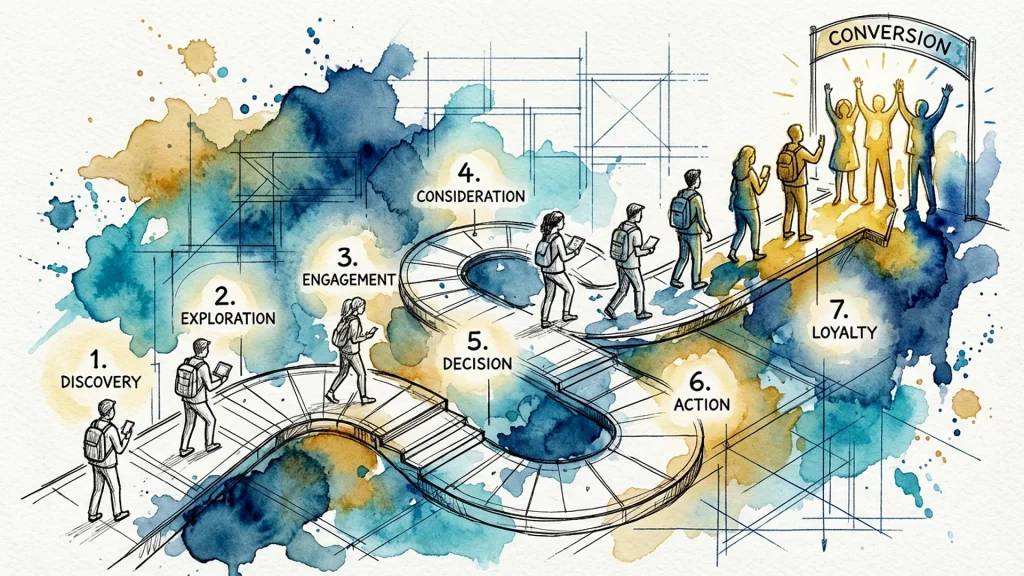
Your website visitors are landing on your homepage, scrolling for three seconds, and leaving without a trace. Sound familiar? The problem isn’t your traffic source or your value proposition—it’s that your website is presenting information when it should be telling a story! In today’s saturated B2B landscape, where decision-makers are drowning in sameness, narrative UX patterns for B2B websites have emerged as the secret weapon that transforms passive browsers into engaged buyers. These aren’t just aesthetic choices; they’re conversion-focused storytelling design patterns backed by cognitive psychology and proven through measurable results. When implemented correctly, these patterns create momentum, reduce cognitive load, and guide prospects through a journey that feels less like a sales pitch and more like a revelation!
Pattern 1: The Before/After Bridge Hero Section
The hero section is your website’s handshake, and most B2B sites waste it with vague promises and corporate jargon. The Before/After Bridge pattern transforms this prime real estate into a narrative hook that immediately connects with your prospect’s pain point!
- Establishes immediate relevance by mirroring the visitor’s current frustration
- Creates a visual or conceptual bridge showing the transformation your service provides
- Positions your solution as the vehicle for change rather than just a list of features
- Reduces bounce rates by creating instant recognition and emotional connection
This before and after narrative design for service businesses works because it leverages the brain’s natural preference for contrast and transformation stories. Instead of leading with “We provide enterprise-grade consulting services,” you open with “Still explaining your complex services three times before prospects understand? Imagine if your website did that work for you.” The psychological principle here is pattern interruption—you’re breaking the expected corporate monotony with a mirror that reflects their specific struggle.
Implementation requires ruthless clarity about your prospect’s actual pain point, not what you assume it is. Interview your best customers about their state before finding you. Use their language, their frustrations, their late-night worries. Then craft a hero section that shows the stark contrast between their current reality and the transformed state you enable. This isn’t manipulation; it’s empathy made visible through design!
Pattern 2: Progressive Disclosure Storytelling
Complex B2B services face a unique challenge: prospects need comprehensive information to make decisions, but overwhelming them with everything at once triggers cognitive overload and abandonment. Progressive disclosure storytelling for complex B2B services solves this brilliantly!
- Reveals information in narrative layers that build on each other logically
- Maintains engagement by creating curiosity gaps that pull visitors deeper
- Reduces overwhelm by presenting complexity in digestible, sequential chunks
- Increases time on site and scroll depth through strategic information architecture
This pattern mirrors how humans naturally process stories—we want just enough information to stay curious, with the promise of deeper revelation ahead. Think of your website as a series of doors, each one answering a question while raising a new, more specific one. Your homepage might address “What problem do you solve?” The next section reveals “How is your approach different?” Further down, you explore “What does the process look like?” Each disclosure earns the right to ask for more attention.
The key to successful implementation is mapping your content to the prospect’s journey of understanding. What do they need to believe first before they can appreciate your methodology? What objection needs addressing before they can consider pricing? This isn’t about hiding information; it’s about sequencing it in a way that aligns with how the human brain naturally processes information from general to specific, from problem to solution. As explained in commercial narrative design: how story-driven websites shorten sales cycles and command premium pricing, this strategic sequencing dramatically reduces the time prospects need to reach decision-readiness!
Pattern 3: The Choose Your Own Adventure Service Selector
When you offer multiple services or serve diverse customer segments, traditional navigation often creates decision paralysis. The Choose Your Own Adventure pattern transforms service selection into an engaging, personalized narrative experience!
- Segments visitors based on their specific situation or primary pain point
- Creates personalized pathways that feel curated rather than generic
- Increases conversion rates by reducing irrelevant information exposure
- Generates valuable data about visitor intent and priorities
This pattern works because it gives visitors agency while simultaneously qualifying them. Instead of forcing prospects to decode which of your five service offerings applies to them, you ask a simple question: “What’s your biggest challenge right now?” or “Which best describes your role?” Based on their selection, the narrative adapts, showing only the most relevant case studies, service details, and calls to action. This is conversion-focused web design at its finest—meeting prospects exactly where they are!
Implementation requires thoughtful segmentation strategy. Don’t create paths based on your internal service structure; create them based on how prospects actually think about their problems. A manufacturing company might segment by production challenges rather than by service names. A consulting firm might segment by organizational size or growth stage. The goal is to make visitors feel like your website is speaking directly to them, creating that magical moment of “This is exactly what I needed!” that drives conversions skyward!
Pattern 4: Social Proof as Subplot
Most websites treat testimonials as an afterthought—a static section that visitors scroll past without engagement. The social proof as subplot pattern weaves customer stories throughout your narrative, creating a parallel storyline that reinforces your main message!
- Distributes testimonials strategically to address specific objections at key decision points
- Uses customer transformation stories as proof points rather than generic praise
- Creates narrative continuity by showing multiple perspectives of the same journey
- Builds trust incrementally rather than asking for a single leap of faith
This approach recognizes that B2B decision-makers don’t just want to know you’re good; they want evidence that you’ve solved problems specifically like theirs. By positioning social proof as a subplot, you’re essentially saying, “Don’t just take our word for it—here’s someone just like you who walked this path.” The psychological power comes from social validation at precisely the moment doubt creeps in. When you claim your process reduces project timelines, immediately follow with a customer quote that validates that exact benefit!
Strategic implementation means mapping your customer testimonials to specific narrative beats. After explaining your methodology, show a testimonial about how that methodology worked in practice. Before your pricing section, include a quote about ROI. This creates a call-and-response rhythm between your claims and third-party validation. For deeper insights on translating complex value into relatable stories, explore from jargon to journey: translating complex B2B services into stories prospects actually understand.
Pattern 5: The Transformation Timeline
B2B buyers fear the unknown, particularly the messy middle between signing a contract and seeing results. The transformation timeline pattern addresses this anxiety by visualizing the journey from current state to desired outcome!
- Maps the specific stages of working with you as a narrative progression
- Reduces anxiety by making the process transparent and predictable
- Creates anticipation by showing what happens at each milestone
- Differentiates your approach by revealing your methodology
This pattern leverages the brain’s love of closure and progression. When prospects can visualize themselves moving through your process, they’re mentally rehearsing becoming your customer. The timeline isn’t just informational; it’s transformational! Instead of saying “We’ll handle everything,” you show “Week 1: Discovery and alignment. Week 2-3: Strategy development. Week 4: Implementation kickoff.” Each stage becomes a chapter in their success story.
Effective implementation requires honesty and specificity. Don’t sanitize the process or skip the challenging parts. If there’s a phase where client input is critical, say so. If results take time to materialize, set that expectation. This transparency builds trust and pre-qualifies prospects who are ready for your actual process, not an idealized version of it. The transformation timeline is essentially B2B website engagement strategies that increase sales by reducing uncertainty and building confidence!
Pattern 6: Objection-Handling Narrative Beats
Every prospect has objections—concerns about cost, implementation time, risk, or fit. Most websites ignore these elephants in the room. The objection-handling narrative beats pattern anticipates and addresses concerns at precisely the right moments in your story!
- Identifies common objections through sales team insights and customer interviews
- Weaves objection-handling seamlessly into the narrative flow
- Reframes objections as opportunities to demonstrate understanding and expertise
- Prevents drop-off by addressing concerns before they become deal-breakers
This pattern works because it demonstrates empathy and confidence simultaneously. When you address an unstated concern, you’re essentially saying, “I know what you’re thinking, and here’s why that’s not actually a problem.” The key is timing—address objections when they naturally arise in the prospect’s mind, not in a defensive FAQ section at the bottom of the page. If you’re explaining your premium pricing, immediately follow with why the investment delivers disproportionate returns.
Implementation requires brutal honesty about what actually holds prospects back. Don’t address strawman objections; tackle the real ones. If prospects worry about implementation disruption, show how you’ve designed your process to minimize it. If they’re concerned about your firm’s size, explain how that’s actually an advantage for personalized attention. This pattern transforms objections from conversion killers into trust-building opportunities!
Pattern 7: The Commitment Escalation CTA Sequence
Asking for a demo or consultation as your only call to action is like proposing marriage on a first date. The commitment escalation CTA sequence recognizes that prospects need smaller commitments before they’re ready for bigger ones!
- Offers multiple conversion paths matched to different readiness levels
- Creates a ladder of engagement from low-commitment to high-commitment actions
- Captures leads at various stages rather than losing not-yet-ready prospects
- Builds relationship progressively through value delivery at each step
This pattern acknowledges that not every visitor is ready to talk to sales today, but that doesn’t mean they won’t be tomorrow. By offering a spectrum of CTAs—from downloading a resource to watching a case study video to scheduling a call—you’re meeting prospects wherever they are in their decision journey. The psychological principle is reciprocity: each value-added interaction increases the likelihood of the next, bigger commitment.
Strategic implementation means designing CTAs that deliver genuine value at each level while naturally leading to the next step. A valuable downloadable resource might end with an invitation to a webinar. The webinar might conclude with an offer for a personalized assessment. Each step earns the right to ask for more. This isn’t manipulation; it’s respecting the prospect’s need to build trust incrementally. To understand how to measure the effectiveness of these patterns, check out measuring narrative ROI: the metrics that prove story-driven websites outperform feature lists.
Bringing It All Together: Your Narrative UX Implementation Roadmap
These seven narrative UX patterns aren’t meant to be implemented in isolation—they work together to create a cohesive, conversion-focused storytelling experience that transforms how prospects engage with your B2B website! The Before/After Bridge hooks attention, progressive disclosure maintains it, the service selector personalizes it, social proof validates it, the transformation timeline visualizes it, objection handling secures it, and commitment escalation captures it. Together, they create an experience that feels less like browsing a website and more like discovering the solution you’ve been searching for!
The businesses winning in saturated markets aren’t those with the best features or the lowest prices—they’re the ones telling the most compelling, clear, and conversion-focused stories. Your complex services deserve more than bullet points and jargon. They deserve narrative architecture that respects how humans actually make decisions! Start by implementing one pattern, measure its impact, then layer in the next. Your prospects are tired of being bored by websites that all look and sound the same. Give them a story worth engaging with, and watch how dramatically your conversion metrics transform. The question isn’t whether narrative UX patterns work—it’s how quickly you can start implementing them to leave your competition wondering what changed!
Frequently Asked Questions
Narrative UX patterns are design and content structures that guide visitors through a story rather than presenting information as a feature list. B2B websites need them because they reduce cognitive load, create emotional connection, and guide prospects through complex decision-making by leveraging how the human brain naturally processes information through narrative sequences rather than static details.
The Before/After Bridge pattern immediately mirrors a visitor’s pain point in the hero section, creating instant recognition and emotional relevance. By showing the stark contrast between their current frustration and the transformed state your service enables, you interrupt the expected corporate monotony and establish relevance within seconds, preventing the three-second scroll-and-leave behavior.
Progressive disclosure storytelling reveals information in narrative layers that build logically on each other, preventing cognitive overload while maintaining engagement. Use this pattern for complex B2B services where prospects need comprehensive information to decide, but overwhelming them with everything at once triggers abandonment. It allows you to guide them through understanding at a sustainable pace.
The key is grounding your narrative in genuine empathy and real customer insights. Interview your best customers about their actual pain points and frustrations before crafting your story. Use their authentic language and concerns rather than assumptions. When your narrative reflects true customer struggles and genuine transformation, it becomes empathy made visible through design, not manipulation.
Narrative UX patterns leverage several psychological principles: pattern interruption (breaking expected corporate monotony), contrast preference (the brain naturally responds to before/after transformations), progressive complexity (reducing cognitive overload), and narrative momentum (stories are inherently more engaging than feature lists). These principles align with how human brains naturally process and retain information.
Traditional B2B design presents information hierarchically with features and benefits listed separately. Conversion-focused storytelling patterns instead guide prospects through a journey that mirrors their actual decision-making process, using narrative beats and emotional connection to reduce friction. This approach positions your solution as the vehicle for change rather than just a list of capabilities.
The most effective approach combines multiple complementary patterns throughout your website journey. Start with the Before/After Bridge in your hero section, layer in progressive disclosure as visitors scroll deeper, and use additional patterns like transformation timelines or objection-handling narrative beats to address different prospect concerns. Each pattern should build on the previous one to create cohesive narrative momentum.