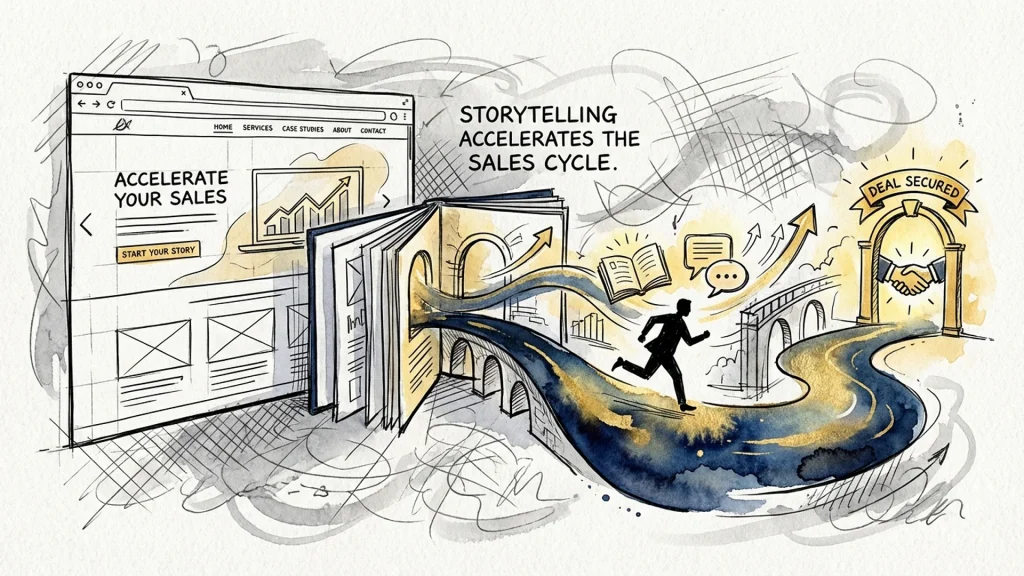
Your website isn’t just failing to convert visitors—it’s actively repelling them! In today’s hyper-competitive B2B landscape, prospects are drowning in a sea of indistinguishable service providers, all claiming to be “industry-leading” and “innovative.” The harsh reality? Most B2B websites function as static digital brochures, listing features and credentials without ever answering the fundamental question prospects desperately need answered: “What happens next if I choose you?” This is where commercial narrative design transforms everything! By implementing narrative-driven website design for B2B sales, companies are discovering they can dramatically shorten sales cycles while simultaneously commanding premium pricing. The secret lies in understanding that human brains don’t process information as disconnected bullet points—they crave stories with clear beginnings, middles, and ends. When your website guides prospects through a logical A → B → C journey, you’re not just presenting information; you’re creating an experience that pre-qualifies leads, builds authority, and makes the buying decision feel inevitable rather than risky!
The Strategic Imperative: Why Commercial Narrative Design Isn’t Optional Anymore
Commercial narrative design represents a fundamental shift in how we approach B2B web development—moving from information architecture to experience architecture! This isn’t about adding a “brand story” page or sprinkling in some customer testimonials. It’s about recognizing that every pixel, every scroll, every transition on your website should contribute to a cohesive narrative that mirrors your sales process and addresses the psychological journey your prospects are already experiencing.
The traditional approach to B2B websites has been transactional and feature-focused. Companies list their services, showcase their credentials, and hope prospects will somehow connect the dots between their offerings and their own business challenges. This approach fundamentally misunderstands how decision-makers evaluate complex services! When you’re selling sophisticated solutions—whether that’s enterprise software, consulting services, or specialized manufacturing—prospects aren’t just comparing features. They’re trying to visualize what their world looks like after implementing your solution, and they’re attempting to assess whether your company truly understands their specific pain points.
Story-driven web development ROI becomes immediately apparent when you examine the metrics that matter most: time-to-close, deal size, and sales team efficiency. Companies implementing narrative-driven frameworks report sales cycles shortened by 30-40% because prospects arrive at discovery calls already educated, aligned, and mentally prepared to move forward. Pre-qualified leads generated through story-driven websites demonstrate higher conversion rates precisely because the narrative has already done the heavy lifting of establishing fit and building trust!
Understanding the A → B → C Framework in Commercial Storytelling
The power of commercial storytelling strategy for lead generation lies in its simplicity and psychological alignment with how humans naturally process information. The A → B → C framework isn’t just a creative device—it’s a cognitive roadmap that reduces mental friction and accelerates decision-making!
Point A represents your prospect’s current state: the frustrations, inefficiencies, and challenges they’re experiencing right now. Effective narrative-driven website design for B2B sales begins by demonstrating deep empathy and understanding of this starting point. This isn’t about listing generic pain points; it’s about articulating the specific, nuanced challenges that make your ideal prospect think, “They get it—they understand my world!” When prospects feel truly seen and understood, they lean in rather than bounce away.
Point B is the transformation—the journey from current state to desired state. This is where most B2B websites completely fail! They jump directly from problem to solution without ever explaining the actual process, the timeline, or what the prospect will experience along the way. The neuroscience of website storytelling reveals that our brains are wired to seek clarity about what happens next. Uncertainty triggers anxiety, and anxiety kills conversions. By clearly articulating the transformation process, you’re not just informing prospects—you’re reducing the perceived risk of working with you.
Point C represents the destination: the tangible outcomes and transformed reality your prospects will experience after implementing your solution. This isn’t about vague promises of “increased efficiency” or “improved performance.” Effective commercial narrative design paints a vivid, specific picture of what success looks like, complete with measurable outcomes and emotional benefits. When prospects can clearly visualize themselves at Point C, the buying decision shifts from “Should we do this?” to “How quickly can we get there?”
Narrative UX Patterns That Increase Conversions
Implementing narrative UX patterns that increase conversions requires understanding that user experience and storytelling aren’t separate disciplines—they’re deeply interconnected! The most effective story-driven websites use specific design patterns that guide prospects through the narrative while maintaining engagement and building momentum toward conversion.
Progressive disclosure is a narrative UX pattern that reveals information in carefully sequenced stages, mirroring the natural progression of a story. Rather than overwhelming visitors with everything at once, progressive disclosure creates a “reveal and reward” experience where each scroll or click provides the next logical piece of the narrative. This approach keeps prospects engaged because they’re always anticipating what comes next, and it prevents the cognitive overload that causes visitors to abandon complex B2B websites.
Contextual navigation represents another powerful pattern where the navigation itself adapts based on where the prospect is in their journey. Seven specific narrative UX patterns have been proven to transform passive visitors into engaged buyers, and contextual navigation ranks among the most effective. Instead of presenting the same static menu to everyone, contextual navigation recognizes that a first-time visitor needs different pathways than someone who’s already explored your case studies or downloaded your resources.
Story-anchored scrolling creates a cinematic experience where the visual and textual narrative unfolds as prospects scroll down the page. This pattern leverages our natural inclination to continue reading when we’re engaged in a compelling story. By synchronizing visual transitions with narrative beats, you create an immersive experience that feels less like reading a website and more like experiencing a presentation specifically crafted for that prospect’s needs. The result? Dramatically increased time-on-site and deeper engagement with your value proposition!
Translating Complex Value Propositions Into Compelling Narratives
The greatest challenge facing B2B companies in saturated markets isn’t differentiation—it’s articulation! Most organizations possess genuinely differentiated value propositions, but they bury them under layers of industry jargon and abstract claims. Translating complex B2B services into stories prospects actually understand requires a systematic approach to extracting the human story from technical specifications.
B2B website storytelling frameworks begin with identifying the transformation your service creates, not the features it includes. This requires a fundamental mindset shift from “what we do” to “what changes for the client.” For example, a cybersecurity firm doesn’t sell “24/7 threat monitoring and incident response”—they sell the ability for CEOs to sleep soundly knowing their company’s data is protected. The technical capabilities enable the transformation, but the transformation is the story!
Successful commercial storytelling strategy for lead generation also demands that you abandon the myth of universal appeal. Generic “we’re different” messaging fails in saturated markets because it attempts to be everything to everyone, resulting in messages that resonate with no one. Effective narrative design requires the courage to speak directly to your ideal prospect, using their language, addressing their specific challenges, and demonstrating understanding of their unique context. Yes, this means some visitors will self-select out—and that’s exactly the point! Pre-qualification isn’t a bug; it’s a feature.
Measuring Success: The ROI of Story-Driven Web Development
Skepticism about brand storytelling ROI typically stems from measuring the wrong metrics! Traditional website analytics focus on surface-level engagement indicators like bounce rate and time-on-page, but these metrics don’t capture the true commercial impact of narrative-driven design. The real ROI reveals itself in business outcomes: shorter sales cycles, higher close rates, larger deal sizes, and reduced sales team effort per closed deal.
Leading indicators of narrative effectiveness include scroll depth on key pages, progression through the narrative sequence, and engagement with story-driven content versus feature lists. When prospects consume your entire narrative—reading case studies, exploring your methodology, and engaging with transformation-focused content—they’re demonstrating buying intent far more clearly than someone who briefly scans your services page. Specific metrics prove story-driven websites outperform feature lists, and tracking these metrics allows you to continuously refine your narrative for maximum commercial impact.
The ultimate ROI measurement, however, comes from sales team feedback and pipeline analysis. When your sales team reports that prospects arrive at discovery calls already educated, aligned, and asking sophisticated questions about implementation rather than basic questions about what you do, you’re witnessing the power of effective commercial narrative design! Similarly, when pipeline velocity increases and deal sizes grow because prospects perceive higher value in your offering, you’re seeing the commercial impact of positioning your services through narrative rather than feature lists.
Implementing Narrative Coherence Across Your Digital Ecosystem
A common mistake in story-driven web development is treating the homepage as the entire narrative! Your homepage is just the opening chapter, and building narrative coherence across your entire digital ecosystem ensures that prospects experience a consistent, compelling story regardless of where they enter or how they navigate your site.
Every page on your website should function as both a standalone narrative and a chapter in the larger story. Landing pages need to establish context quickly while connecting to the broader narrative arc. Service pages should expand on specific aspects of the transformation without losing sight of the overall journey. Case studies need to demonstrate the A → B → C progression with real-world examples that reinforce your primary narrative. When every element works together, you create a compound effect where the whole becomes greater than the sum of its parts!
This coherence extends beyond your website to every digital touchpoint: email sequences, social media content, sales presentations, and even your proposal documents. Prospects interact with your brand across multiple channels and touchpoints, and narrative consistency across all of them reinforces your positioning and accelerates trust-building. When a prospect reads your LinkedIn content, visits your website, and then receives a follow-up email, they should experience a seamless narrative thread that makes your value proposition increasingly clear and compelling!
Auditing Your Current Website: Digital Brochure or Sales Tool?
Most B2B websites fall into the “digital brochure” trap without their owners even realizing it! Five clear signs reveal whether you’ve built a digital brochure instead of a sales tool, and honestly assessing your current site against these criteria is the first step toward transformation. Does your homepage clearly articulate the specific problem you solve, or does it lead with vague claims about being “trusted” or “innovative”? Do your service pages explain what the prospect experiences when working with you, or do they simply list capabilities and credentials?
A CEO’s website audit using ten strategic questions can reveal whether your site builds authority or undermines it. These questions go beyond aesthetics and technical performance to examine whether your website functions as a strategic asset that advances prospects through their buying journey. When you view your website through this lens—as a sales tool rather than a marketing asset—the gaps become immediately apparent, and the path to improvement becomes clear!
The transformation from digital brochure to narrative-driven sales tool doesn’t require a complete rebuild overnight. It begins with strategic repositioning of your core messaging, followed by systematic implementation of narrative UX patterns, and continuous refinement based on how prospects actually engage with your content. The companies winning in saturated markets aren’t necessarily those with the best services—they’re the ones who tell the most compelling, clear, and commercially effective stories about the transformations they create!
The future of B2B web development isn’t about flashier animations or more sophisticated technology—it’s about harnessing the timeless power of narrative to create clarity, build trust, and accelerate decision-making! Commercial narrative design represents a fundamental shift from hoping prospects will figure out your value to deliberately guiding them through a journey that makes choosing you feel like the only logical next step. When you implement narrative-driven website design for B2B sales, you’re not just improving your website—you’re transforming it into your most effective sales team member, working 24/7 to pre-qualify leads, establish authority, and shorten sales cycles. The question isn’t whether you can afford to invest in story-driven web development; it’s whether you can afford to keep boring prospects with a digital brochure while your competitors captivate them with compelling narratives! Start evaluating your website today through the lens of commercial storytelling, and you’ll discover opportunities to transform passive visitors into engaged buyers who arrive at sales conversations already convinced of your value!
Frequently Asked Questions
Commercial narrative design transforms websites from static feature lists into guided storytelling experiences that mirror the buyer’s journey. Unlike traditional B2B websites that present disconnected information, narrative-driven website design creates a logical A → B → C progression that helps prospects visualize their future after implementing your solution, ultimately shortening sales cycles by 30-40%.
Story-driven websites pre-qualify leads by educating prospects before they ever contact your sales team, meaning they arrive at discovery calls already aligned and mentally prepared to move forward. This narrative-driven approach reduces friction in the buyer’s journey, leading to faster decisions, higher conversion rates, and the ability to command premium pricing because prospects clearly understand your value proposition.
The human brain is hardwired to process information through stories rather than disconnected bullet points—narratives create emotional engagement and memory retention that feature lists simply cannot achieve. When your website guides prospects through a clear narrative journey, you’re not just presenting information; you’re creating an experience that builds authority and makes the buying decision feel inevitable rather than risky.
In crowded markets where competitors claim similar credentials, narrative-driven web development helps you stand out by answering the question prospects desperately need answered: ‘What happens next if I choose you?’ A compelling commercial storytelling strategy differentiates your brand by demonstrating deep understanding of prospect pain points and clearly articulating the transformation your solution delivers.
Track metrics that directly impact revenue: time-to-close, deal size, sales team efficiency, and the percentage of prospects arriving at discovery calls pre-qualified. Story-driven websites also reduce the number of discovery calls needed per closed deal because the narrative has already addressed common objections and aligned prospects with your solution’s value proposition.
Adding testimonials is a tactical addition; narrative UX patterns represent a structural redesign where every pixel, scroll, and transition contributes to a cohesive story that mirrors your sales process. True narrative-driven web development weaves customer success stories, your methodology, and prospect pain points into an integrated experience that guides visitors toward natural next steps, rather than treating stories as isolated page elements.
Yes—narrative-driven website design is especially powerful for complex services because it helps prospects visualize implementation and outcomes that are otherwise abstract. By translating sophisticated value propositions into clear A → B → C journeys, you make complex solutions feel more accessible, reduce perceived risk, and demonstrate that your company truly understands their specific business challenges.