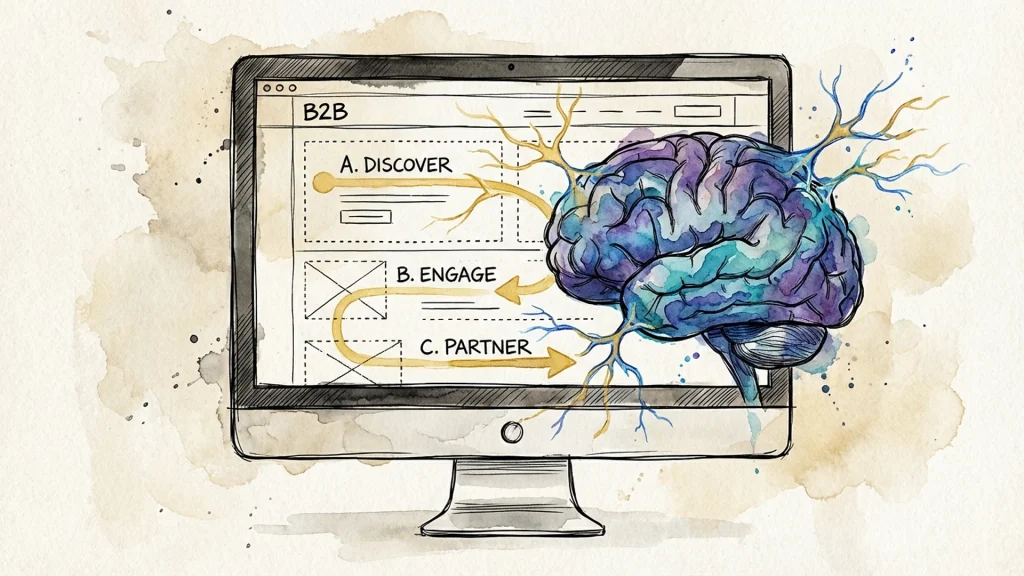
Your website has three seconds. That’s it! Three fleeting seconds to capture attention, communicate value, and convince a visitor to keep reading. Yet most B2B websites squander this precious window with scattered information, disconnected feature lists, and navigation that sends prospects bouncing around like pinballs. Here’s the fascinating truth: the human brain isn’t designed to process information this way. Neuroscience reveals that our minds are hardwired for something entirely different—sequential narratives that follow a clear A → B → C structure. This isn’t just interesting psychology; it’s the secret weapon behind websites that convert browsers into qualified leads!
Understanding the neuroscience of storytelling for business websites transforms how you approach web design. When you align your digital presence with how the brain naturally processes information, something remarkable happens. Prospects engage longer, comprehend faster, and arrive at sales conversations already convinced of your value. Let’s dive into the brain science that explains why narrative-driven websites dramatically outperform their feature-focused competitors!
How Your Brain Actually Processes Information
The human brain is an incredible pattern-recognition machine, constantly searching for connections and sequences. When we encounter random, disconnected pieces of information, our cognitive systems struggle. This struggle has a name: cognitive load. Think of cognitive load as the mental effort required to process what you’re experiencing. The higher the load, the faster visitors abandon your website!
Cognitive load theory, developed by educational psychologist John Sweller, reveals something crucial for web design. Our working memory can only handle about four chunks of information simultaneously. When websites bombard visitors with unrelated facts, statistics, and features scattered across a page, they’re essentially asking the brain to juggle too many balls at once. The result? Mental exhaustion and a quick exit to your competitor’s site.
However, when information follows a narrative sequence—moving logically from point A to point B to point C—something magical happens. The brain shifts into story-processing mode, a fundamentally different cognitive state. Narrative structures reduce cognitive load because they provide a framework for organizing information. Instead of holding seven disconnected facts in working memory, visitors follow a single thread that weaves those facts into a coherent journey.
Research from Princeton University demonstrates this beautifully. When people listen to stories, their brain activity synchronizes with the storyteller’s brain through a phenomenon called neural coupling. This synchronization doesn’t occur when processing lists or random information clusters. The implications for sequential UX design are profound: websites structured as narratives literally align your prospects’ thinking with your message!
The Dopamine-Driven Engagement Loop
Let’s talk about the brain’s reward system and why it matters for your website! Dopamine, often called the “motivation molecule,” plays a starring role in how prospects engage with your content. Here’s what makes this so powerful: dopamine isn’t released when we get answers—it’s released in anticipation of answers. This creates what neuroscientists call the curiosity-driven engagement loop.
When your website presents information as a narrative with clear progression, each section creates a small information gap. The brain recognizes that resolution is coming (point B will explain point A, point C will resolve the tension created by B), and this anticipation triggers dopamine release. Your prospects literally feel rewarded for continuing their journey through your content!
Traditional websites kill this engagement loop. When visitors can see everything at once—all features, all benefits, all calls-to-action competing for attention—there’s no anticipation, no curiosity gap, and therefore no dopamine-driven motivation to continue. It’s like reading the last page of a mystery novel first. The neurochemical reward system simply doesn’t engage.
Story-driven web design leverages this biological reality brilliantly. By structuring content sequentially, you create multiple micro-moments of curiosity and resolution. Each section answers previous questions while raising new ones, maintaining dopamine engagement throughout the visitor’s journey. This isn’t manipulation; it’s alignment with how brain processes narrative structures naturally!
Why A → B → C Mirrors Natural Information Processing
Human beings have been processing information through stories for thousands of years. Long before written language, our ancestors shared knowledge through narrative sequences around campfires. This evolutionary history means our brains have developed specialized neural pathways for story comprehension. These pathways activate automatically when we encounter narrative structure, making information processing effortless and intuitive.
The A → B → C framework specifically mirrors how we naturally understand cause and effect. Point A establishes context and identifies a problem or opportunity. Point B introduces transformation or solution. Point C demonstrates outcome and resolution. This sequence matches the fundamental structure of human experience: situation, action, result. When websites follow this pattern, they tap into deeply ingrained cognitive processes.
Consider how this applies to complex B2B services. Your prospects face sophisticated challenges that can’t be explained in a tagline. Traditional websites try to compress everything into hero sections and feature grids, forcing visitors to piece together the value proposition themselves. This approach fights against how the brain naturally processes narrative psychology sales lead qualification!
Alternatively, narrative-structured websites guide prospects through a logical progression. First, they establish the business landscape and challenges (A). Then, they introduce your methodology and approach (B). Finally, they demonstrate outcomes and transformation (C). This sequence doesn’t just inform—it persuades by aligning with the brain’s natural comprehension pathways. Prospects who complete this journey arrive at sales conversations already understanding and believing your value proposition.
The Pre-Qualification Power of Narrative Completion
Here’s where narrative psychology becomes a game-changer for sales teams! When prospects complete a narrative journey on your website, they’ve done something psychologically significant. They’ve invested time and mental energy following your story from beginning to end. This investment creates what behavioral economists call the “sunk cost effect,” making visitors more committed to the relationship.
More importantly, narrative completion serves as a powerful qualification mechanism. Prospects who aren’t a good fit typically exit early—they recognize the story isn’t about them or their challenges. However, those who resonate with your narrative continue through to the conclusion. By the time they reach your contact form or schedule a call, they’ve self-selected based on alignment with your value proposition.
This stands in stark contrast to websites that make contacting you too easy, too early. When your call-to-action appears before prospects understand your methodology and value, you generate unqualified leads. Your sales team wastes hours explaining basics to people who aren’t ready, aren’t aligned, or aren’t the right fit. It’s exhausting and expensive!
The neuroscience backs this up. When people complete narratives, their brains release oxytocin, sometimes called the “trust hormone.” This neurochemical response increases feelings of connection and trust. Prospects who finish your website’s narrative journey literally arrive at sales conversations with elevated trust levels compared to those who simply clicked a button after reading a tagline. That’s the power of commercial narrative design: how story-driven websites shorten sales cycles and command premium pricing!
Cognitive Load Theory and Complex Service Explanations
B2B companies offering sophisticated services face a unique challenge. Your value proposition can’t be reduced to simple feature comparisons. You’re selling transformation, methodology, expertise, and outcomes that unfold over time. Traditional web design, with its emphasis on scannable content and instant comprehension, fundamentally fails to communicate this complexity.
Cognitive load theory offers a solution through what’s called “worked examples.” Instead of presenting abstract concepts, narrative-driven websites walk prospects through concrete scenarios that demonstrate your approach in action. This storytelling technique dramatically reduces the mental effort required to understand complex services because the brain processes stories using different, more efficient neural pathways than it uses for abstract information.
Think about how you’d explain your services to someone over coffee. You wouldn’t hand them a feature list! You’d tell them about a client who faced specific challenges, describe how your methodology addressed those challenges, and share the results. This narrative approach works because it provides context, demonstrates causation, and makes abstract concepts concrete through specific examples.
Your website should function the same way. By structuring content as sequential narratives rather than information clusters, you make complex services comprehensible without oversimplifying. Prospects can follow the logic of your approach, understand the why behind your methodology, and envision themselves experiencing similar transformations. This deep comprehension is what separates qualified leads from casual browsers!
Implementing Brain-Friendly Sequential Design
Understanding the neuroscience is one thing; implementing it is another! The good news is that brain-friendly sequential UX design follows clear principles. Start by mapping your ideal client’s journey not as a sales funnel, but as a story arc. What’s their starting situation? What transformation do they need? What does success look like? These three questions correspond directly to your A → B → C structure.
Next, resist the temptation to give everything away in your hero section. Your homepage should establish point A—the context and challenge your prospects face. It should create just enough curiosity to motivate scrolling or clicking to the next section. Remember, dopamine engagement requires information gaps, not information dumps!
As visitors progress through your site, each section should answer previous questions while raising new ones. Point B sections should detail your methodology, approach, or solution, but in ways that create anticipation for outcomes. Point C sections deliver the resolution—case studies, results, transformations—that satisfy the curiosity you’ve been building.
Finally, place your strongest calls-to-action after prospects have completed the narrative journey. This doesn’t mean hiding contact information; it means strategically positioning your primary conversion points where they’ll attract the most qualified leads. Those who’ve invested in understanding your complete story are exponentially more valuable than those who click impulsively after reading a headline. This approach directly supports how story-driven websites pre-qualify leads so sales teams stop wasting time on bad-fit prospects!
The Measurable Impact on Sales Conversations
The ultimate test of any website strategy is business impact. Narrative-driven websites don’t just feel better or look more sophisticated—they deliver measurable improvements in sales efficiency and conversion rates. When prospects arrive at sales conversations having completed your website’s narrative journey, the dynamics change fundamentally.
Sales teams report dramatically shorter discovery calls because prospects already understand the methodology. Objection handling becomes easier because the narrative has pre-addressed common concerns. Pricing conversations flow more smoothly because the story has established value context. These aren’t minor improvements; they’re transformative changes that compound across every sales interaction!
Moreover, the quality of leads increases substantially. Narrative completion acts as a filter, ensuring that only genuinely interested, well-aligned prospects request conversations. This means your team spends less time qualifying and more time closing. The ROI implications are significant, particularly for businesses with complex, high-value services where sales cycle length directly impacts profitability. For concrete evidence of these improvements, explore measuring narrative ROI: the metrics that prove story-driven websites outperform feature lists.
The science is clear: human brains are wired for stories, not feature lists. By aligning your website structure with how the brain naturally processes information through sequential narratives, you create a digital presence that engages deeper, communicates clearer, and converts better. This isn’t about tricks or manipulation—it’s about respecting the cognitive architecture that evolution has given us. Your prospects’ brains are already optimized for A → B → C narratives. The question is: will your website meet them where their neurology lives, or will you continue fighting against millions of years of evolutionary programming? The choice is yours, but the science points to only one answer!
Frequently Asked Questions
The human brain is wired for pattern recognition and sequence processing. When information follows a logical narrative flow from point A to B to C, your working memory can follow a single coherent thread instead of juggling disconnected facts. This narrative structure reduces cognitive load—the mental effort required to process information—allowing prospects to engage longer and comprehend faster than when reading scattered feature lists.
Cognitive load theory, developed by psychologist John Sweller, explains that working memory can only handle about four chunks of information simultaneously. When B2B websites overwhelm visitors with unrelated facts, statistics, and features scattered across pages, they create excessive cognitive load that leads to mental exhaustion and quick exits. Sequential UX design minimizes this load by organizing information into a narrative journey that prospects can follow naturally.
Research from Princeton University shows that when people listen to stories, their brain activity synchronizes with the storyteller’s brain through neural coupling. This synchronization doesn’t occur when processing random information clusters or feature lists. By structuring your website as a narrative, you literally align your prospects’ cognitive patterns with your message, creating deeper engagement and faster comprehension of your value proposition.
Dopamine is released when our brains anticipate resolution or closure in a story. When prospects follow an A→B→C narrative on your website, each progression triggers dopamine release, creating curiosity and sustained engagement. This neurochemical response keeps visitors invested in completing your narrative journey, making them more likely to reach your call-to-action already convinced of your value rather than bouncing after three seconds.
When your website guides prospects through a clear narrative journey that mirrors how their brain naturally processes information, you pre-qualify leads by design. Prospects who complete the full A→B→C narrative have already internalized your value proposition and aligned their thinking with your solution. This means sales conversations start with already-engaged, better-qualified leads rather than prospects who need convincing on basic value.
When processing stories, the brain shifts into a fundamentally different cognitive state that synchronizes with the narrative structure. Disconnected information requires the brain to hold multiple unrelated facts in working memory simultaneously, creating cognitive strain. Stories provide a framework that organizes information into a coherent sequence, dramatically reducing mental effort and allowing prospects to retain information longer while staying engaged with your message.
Start by mapping your value proposition as a clear A→B→C sequence: A is the prospect’s current problem or situation, B is the transformation your solution enables, and C is the outcome or result they achieve. Then organize your website content—headlines, copy, visuals, and calls-to-action—to guide visitors through this logical progression rather than presenting disconnected features. This alignment with how brains naturally process narratives converts browsers into qualified leads ready for sales conversations.