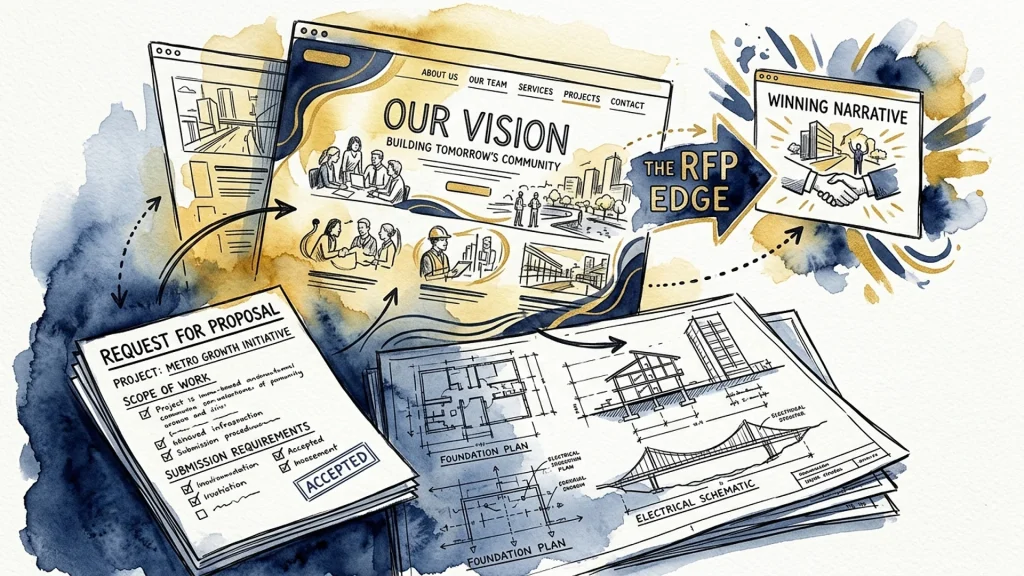
Picture this: your firm has spent weeks crafting a compelling proposal for a major infrastructure project. The written submission is tight, your pricing is competitive, and your team’s qualifications are genuinely impressive. But somewhere between submission and the shortlist announcement, something goes wrong. You don’t make the cut. What happened? In many cases, the answer is sitting right there on your website. Selection committees routinely research firms online before, during, and after reviewing formal submissions. If your digital presence tells a different story than your proposal, or worse, tells no story at all, you’re already behind before the evaluation even begins. A strong construction RFP website strategy isn’t a luxury anymore. It’s a competitive necessity that directly influences winning construction bids online and shortening your path to the shortlist.
The Hidden Evaluation: How Selection Committees Use Your Website
- Procurement teams research firms digitally before formal scoring begins
- Websites serve as a credibility checkpoint during the RFP review process
- A weak digital presence creates doubt that undermines even strong proposals
Most construction and engineering firms treat their websites as passive marketing tools. Selection committees treat them as active evaluation resources. There’s a critical gap between those two perspectives, and it costs firms real revenue.
Procurement professionals, owners’ representatives, and project selection committees are busy people. They don’t have time to read every word of every proposal with equal depth. However, they do take time to search for firms online. They look for visual evidence of past work, signals of organizational maturity, and confirmation that your firm is the caliber they expect. Your construction proposal digital presence either reinforces their confidence or introduces doubt.
Think about the psychology at play here. A committee member reads your proposal, feels intrigued, and then Googles your firm. If they land on an outdated website with blurry project photos and generic copy, their enthusiasm deflates. Conversely, if they land on a dynamic, story-driven platform that visually demonstrates your capabilities and communicates your values clearly, their confidence grows. That confidence translates directly into scoring behavior, even when evaluators don’t consciously realize it.
Digital Pre-Qualification: Your Website as a Living Credential
- Digital pre-qualification happens before firms are even invited to bid
- Owners use websites to assess capability, culture, and project scale fit
- A strong digital presence expands your access to high-value opportunities
Here’s a concept that should reshape how you think about your website: digital pre-qualification. Before a formal RFP is even issued, many owners and project managers are quietly researching potential firms. They’re building mental shortlists based on digital impressions. If your website doesn’t communicate your project scale, specialized capabilities, and organizational credibility, you may never receive an invitation to bid in the first place.
This is especially critical for mid-to-large-scale industrial firms competing for complex projects. Owners want partners who feel like peers, not vendors. Your website needs to project that peer-level confidence from the very first glance. A compelling narrative that walks visitors through your firm’s history, values, and signature projects creates that impression powerfully. It signals that your firm understands the weight of large-scale work and has the depth to deliver it.
For more insight on building that kind of credibility from the ground up, explore our comprehensive guide on story-driven digital presence for construction firms: the playbook for winning trust, credibility, and high-value bids.
Aligning Your Website Content With RFP Evaluation Criteria
- RFP scoring criteria map directly to specific website content opportunities
- Experience, safety, team qualifications, and past performance are key categories
- Strategic content alignment turns your website into a proposal support tool
Most RFPs evaluate firms across consistent categories: relevant experience, safety record, key personnel qualifications, financial stability, and past performance. Here’s the exciting part: every single one of those categories has a direct website content equivalent. Your job is to align them strategically!
Relevant experience maps to detailed project case studies that go beyond a simple photo and project name. Write narratives that describe the challenge, your approach, and the measurable outcome. Safety record maps to a dedicated safety culture page that communicates your EMR (Experience Modification Rate), certifications, and safety philosophy with genuine depth. Team qualifications maps to robust leadership and team pages that highlight credentials, years of experience, and individual project contributions. Past performance maps to client testimonials and references that are specific, credible, and emotionally resonant.
When a selection committee member reads your proposal and then visits your website, they should find a seamless continuation of the same story. That coherence between your written submission and your digital presence is what separates firms that consistently make the shortlist from those that consistently don’t. If you’re concerned your current site is already working against you, why your construction website is losing you bids (and you don’t even know it) is essential reading.
Project Case Studies as Living Proposal Supplements
- Case studies serve as verifiable, detailed proof of claims made in proposals
- Story-driven case studies create emotional connection alongside factual evidence
- They can be referenced directly in proposals to extend your narrative
Your proposal has page limits. Your website doesn’t. That’s a massive strategic advantage if you use it correctly! Detailed project case studies on your website function as living supplements to your formal submission. You can reference them directly in your proposal, inviting evaluators to visit specific pages for deeper project documentation, additional photography, and client feedback.
The key is to write case studies as stories, not data sheets. Start with the project challenge. Describe what was at stake. Walk through your team’s approach and the obstacles they overcame. Finish with measurable outcomes and a client quote that validates the result. This narrative structure aligns with how the human brain naturally processes information: A leads to B, and B leads to C. Evaluators don’t just read these case studies; they experience them. That experience builds trust far more effectively than a list of project specs ever could.
For a detailed breakdown of which pages matter most to procurement teams, check out 7 construction website pages that make procurement teams take you seriously.
Capability Pages That Speak the Language of Procurement
- Capability pages must go beyond service lists to demonstrate specialized expertise
- Procurement teams look for evidence of sector-specific experience and depth
- Strategic content positions your firm as the obvious choice for specialized scopes
Generic capability pages are everywhere in the construction industry. “We do commercial, industrial, and civil work.” Great. So does everyone else on the shortlist. What makes your firm the right choice for this specific project? Your capability pages need to answer that question directly and compellingly.
Effective capability pages go deep into your firm’s specialized experience within specific sectors or project types. They highlight proprietary methods, unique equipment, specialized certifications, and the specific challenges your team is exceptionally equipped to handle. They speak the technical language of procurement professionals without becoming inaccessible to non-technical decision-makers. That balance requires real copywriting skill combined with genuine industry knowledge, which is exactly why story-driven approaches outperform generic content every single time.
Turn Your Digital Presence Into Your Most Powerful Bid Tool
Your website is working for you or against you during every single RFP evaluation. There’s no neutral ground. Selection committees are researching your firm right now, forming impressions that shape how they score your proposals and whether they invite you to bid in the future. The firms that understand this reality and invest in a strategic, story-driven digital presence gain a compounding competitive advantage that grows with every bid cycle.
The good news is that the gap between where most construction websites are today and where they need to be is absolutely closeable! With the right narrative framework, strategic content alignment, and compelling visual storytelling, your website transforms from a passive brochure into an active bid-winning asset. Your firm has built an impressive legacy through hard work and expertise. It’s time your digital presence told that story with the same power and conviction that your team brings to every project site. Start building your construction pre-qualification website strategy today, and watch the shortlist invitations follow.